

TL;DR:
- In small apartments every furniture piece significantly impacts space and function.
- Multi-purpose furniture can save up to 35% of floor space and increase usability.
- Intentional, curated choices of furniture enhance comfort and style without clutter.
Most urban apartments clock in at just 457 sq ft, yet the right furniture can make that space feel twice as livable. Living small doesn’t mean living less. It means making smarter choices. The furniture you pick isn’t just decoration. It defines how you move, work, rest, and entertain in your home. This guide walks you through practical, data-backed strategies to get more comfort, more function, and more style out of every square foot you have.
Table of Contents
- Why furniture matters more in small spaces
- Core principles for furnishing small spaces
- Maximizing functionality: Multi-purpose and smart furniture
- Practical challenges and expert solutions for micro-apartments
- A fresh perspective: Quality, curation, and true small-space living
- Find your ideal small-space furniture solutions
- Frequently asked questions
Key Takeaways
| Point | Details |
|---|---|
| Maximize space with smart furniture | Choose multi-functional and vertical pieces to make the most of every square foot in small apartments. |
| Prioritize usability | Select furniture that is genuinely comfortable and practical for daily life, not just for added storage. |
| Test before you buy | Ensure mechanisms work in your real space and measure all pathways and clearances for easy delivery and use. |
| Curate for comfort and style | A well-chosen mix of versatile pieces with personal touches creates a welcoming, uncluttered home. |
Why furniture matters more in small spaces
In a compact apartment, every piece of furniture carries more weight than it would in a larger home. There’s no spare room to hide a clunky armchair or an oversized bookshelf. What you bring in either works for you or against you. Furniture is the primary tool for creating distinct zones in an open-plan studio, separating your sleeping area from your workspace without a single wall.
Visually light pieces, like chairs with slim legs or glass-topped tables, keep a room from feeling boxed in. Bulky, dark furniture does the opposite. It compresses the visual field and makes a room feel smaller than it actually is. The difference between a cramped studio and a comfortable one often comes down to these choices, not the square footage itself.
Without intentional furniture decisions, urban dwellers often run into the same set of problems:
- No clear zones: Living, sleeping, and working areas blur together, creating mental fatigue.
- Lost floor space: Oversized pieces eat up walking room and make the apartment feel cluttered.
- Poor storage: Without built-in options, surfaces become dumping grounds.
- Visual noise: Too many mismatched pieces make a small room feel chaotic.
- Wasted vertical space: Walls above eye level go unused while floor space runs out.
“Furniture in small urban apartments primarily serves to maximize space through multifunctionality and vertical utilization.”
This is why optimizing living room layout starts with furniture selection, not paint color or lighting. Get the pieces right, and everything else falls into place.
Core principles for furnishing small spaces
Knowing that furniture matters is one thing. Knowing how to choose it is another. A clear framework makes the process far less overwhelming. These furnishing guidelines consistently point to the same core principles: scale-proportion, zoning, vertical expansion, visual lightness, and integrated storage.
Here’s how to apply each one:
- Scale and proportion: Choose fewer, larger pieces rather than many small ones. A single well-sized sofa reads as intentional. Five mismatched chairs read as clutter.
- Zoning: Use rugs, shelving, or furniture placement to define areas. A bookshelf can act as a room divider without blocking light.
- Vertical expansion: Mount shelves 12 to 16 inches off the floor to free up surface area. Use tall storage units that draw the eye upward.
- Visual lightness: Prioritize furniture with exposed legs, open frames, or transparent materials. These pieces take up physical space without dominating the visual field.
- Integrated storage: Every piece should earn its place. Ottomans with storage, beds with drawers, and benches with compartments all pull double duty.
| Furniture type | Traditional version | Space-saving version | Estimated space saved |
|---|---|---|---|
| Coffee table | Solid wood, fixed top | Lift-top with storage | Up to 20% |
| Sofa | Standard 3-seater | Sofa bed with storage | Up to 30% |
| Dining set | Table plus 4 chairs | Wall-mounted fold-down table | Up to 40% |
| Shelving | Freestanding bookcase | Floating wall shelves | Up to 15% |
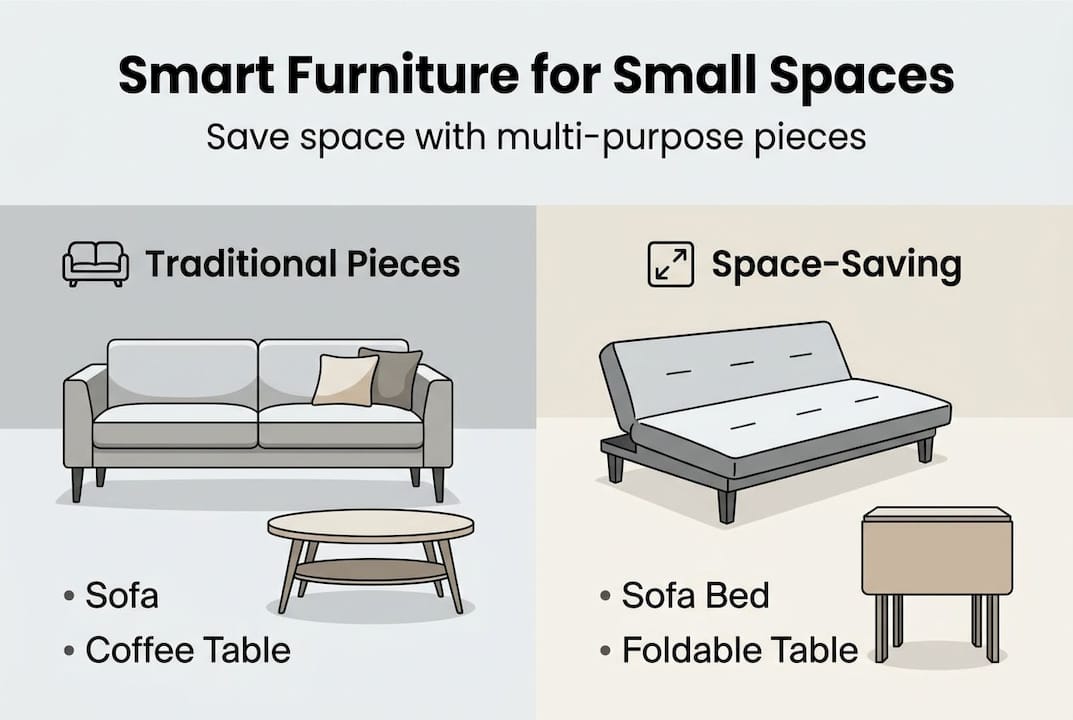
Dimensions matter too. Standard stool height is 18 inches, which tucks neatly under most counters. Floating shelves work best at 12 to 16 inches deep. These small measurements add up to big gains in usable space. Good lighting tips for small spaces and smart home zoning strategies work hand in hand with these furniture principles.
Pro Tip: Before buying any multi-functional piece, physically test the mechanism in the store. A sofa bed that’s hard to open or a lift-top table with stiff hinges will go unused within weeks.
Maximizing functionality: Multi-purpose and smart furniture
Armed with these principles, let’s look at specific furniture solutions that deliver measurable results. Multi-purpose furniture isn’t a trend. It’s a practical response to real constraints. Multi-functional designs save 30 to 35% of floor space compared to traditional setups, with user satisfaction ratings averaging 4.4 out of 5. Those numbers reflect real-world use, not just showroom appeal.

| Feature | Multi-purpose furniture | Traditional furniture |
|---|---|---|
| Floor footprint | Compact, dual-use | Single-function, larger |
| Storage | Built-in compartments | Separate storage needed |
| Daily usability | High, adaptable | Moderate, fixed use |
| User satisfaction | 4.4/5 | 3.8/5 |
| Space efficiency | 30 to 35% better | Baseline |
The gains are real. Here are proven solutions that work especially well in city apartments:
- Lift-top coffee tables: Convert from surface to workspace in seconds, eliminating the need for a separate desk.
- Sofa beds with storage: Guest-ready and clutter-free without a dedicated guest room.
- Nesting tables: Stack when not in use, expand when you need extra surface area.
- Murphy beds with integrated shelving: Reclaim your entire bedroom floor during the day.
- Storage ottomans: Serve as seating, footrests, and hidden storage all at once.
- Modular shelving systems: Reconfigure as your needs change without buying new pieces.
Exploring multi-functional living room furniture can reveal options you hadn’t considered. And styling for function ensures these pieces look as good as they perform. The key is selecting pieces where the secondary function is just as easy to use as the primary one.
Practical challenges and expert solutions for micro-apartments
Super-functional furniture solves most problems, but real urban living comes with constraints that no catalog photo shows. Tight stairwells, narrow elevator doors, and small entryways can make delivery a genuine obstacle. A sofa that looks perfect online might not fit through your front door.
Flat-pack furniture and high-durability materials are essential for micro-apartments precisely because of these delivery realities. Modular designs that assemble on-site sidestep the tight-corridor problem entirely. Lightweight frames, typically 18 to 22 pounds for accent chairs, are easier to reposition as your layout needs shift.
When evaluating materials and durability, keep these benchmarks in mind:
- Fabric durability: Look for upholstery rated at Martindale 20,000 rubs or higher for everyday seating.
- Frame material: Solid wood or steel frames outlast particleboard in high-use furniture.
- Weight: Chairs under 22 pounds are easy to move for cleaning or reconfiguring.
- Mechanism quality: Fold-out beds and convertible tables should open and close with one hand.
- Finish resistance: Scratch-resistant and easy-clean surfaces matter more in small spaces where every surface is visible.
Usability is just as important as the feature list. A fold-out dining table that requires 36 inches of clearance to open is useless in a hallway-adjacent kitchen. Always map out the full range of motion before you buy. Choosing modern furniture for daily use means prioritizing pieces that work in real conditions, not just ideal ones.
Pro Tip: Measure every path from your building entrance to your apartment door, including elevator width and any tight corners. Aim for at least 30 to 36 inches of clearance for comfortable delivery and daily movement.
A fresh perspective: Quality, curation, and true small-space living
Here’s something many small-space guides won’t tell you: more storage doesn’t automatically mean a better home. We’ve seen it happen repeatedly. Someone buys every clever gadget and modular unit available, and their apartment still feels chaotic. Why? Because the problem was never a lack of storage. It was a lack of curation.
The most comfortable small apartments we’ve encountered share one trait. Every piece has a clear reason to be there. Not because it was on sale, not because it technically fits, but because it reflects how the person actually lives. That kind of intentionality is harder to achieve than buying the right ottoman.
“Quality and personality enhance coziness without clutter” is the principle that separates a truly livable small space from one that just checks boxes.
Invest in fewer pieces that you genuinely enjoy using every day. A comfortable chair you reach for every evening is worth more than three storage units you resent opening. Avoiding common furniture mistakes often comes down to resisting the urge to fill every corner and trusting that open space is not wasted space. Living well in a small apartment is as much about self-knowledge as it is about square footage.
Find your ideal small-space furniture solutions
Ready to put these principles into practice? Your apartment deserves furniture that works as hard as you do, without sacrificing the style that makes it feel like home.
At New Way Ref, we’ve thoughtfully curated collections designed with compact urban living in mind. Browse our home decor essentials for pieces that add personality without clutter. Explore our kitchen and home must-haves for functional upgrades that fit your space and your lifestyle. From multi-purpose accent pieces to stylish storage solutions, every item is selected to help you get more from your home. Free shipping on orders over $50 makes it even easier to start transforming your space today.
Frequently asked questions
What kind of furniture works best in a 300 to 500 sq ft apartment?
Multifunctional furniture and vertical storage maximize utility and keep smaller apartments feeling open and organized. Wall-mounted shelving and visually light pieces are especially effective in this size range.
How much space can multi-purpose furniture really save?
Multi-purpose designs save 30 to 35% of floor space compared to traditional furniture setups, based on empirical research. That’s a meaningful gain in a 400 square foot apartment.
What should I watch out for when buying furniture for a tiny apartment?
Always verify that delivery is feasible through your building’s entry points, and choose pieces with flat-pack or modular assembly for easier installation. Durable mechanisms that work smoothly every day matter more than novelty features.
Should I choose more small pieces or fewer larger ones?
Fewer, well-scaled larger pieces generally make a room feel more open and coherent than a collection of small items. Scale and proportion are foundational to making a small space feel intentional rather than cluttered.
Recommended
- Why Optimize Living Room Layout for City Life – New Way Ref
- Types of living room furniture: 40% more storage & space – New Way Ref
- What is space planning? Transform your home for comfort – New Way Ref
- Lighting tips for small spaces to brighten urban homes – New Way Ref
- 7 Smart Office Space Design Ideas for Modern Businesses – Mats4U USA