

TL;DR:
- Sustainable interior design considers the full lifecycle of materials, environmental impact, and occupant health. It emphasizes repair, durability, and verifying credibility over superficial green labels to avoid greenwashing. Small, mindful choices, like maintaining existing items and selecting certified materials, have a greater long-term impact than dramatic upgrades.
Slapping an “eco-friendly” label on a bamboo bath mat is not sustainable interior design. True sustainability means thinking about where every material came from, how it affects your indoor air quality today, and where it ends up years from now. Sustainable interior design addresses the full lifecycle of materials and their impact on both the environment and human health, not just surface-level green features. This guide cuts through the noise so you can make smarter, more confident choices for your home.
Table of Contents
- Sustainable interior design: What it really means
- Key pillars of sustainable interior design
- How to choose sustainable materials and furnishings
- Verifying sustainability claims: Avoiding greenwashing
- Why starting small has the biggest impact in sustainable design
- Design your sustainable home with New Way Ref
- Frequently asked questions
Key Takeaways
| Point | Details |
|---|---|
| Look beyond green labels | True sustainable design focuses on lifecycle impacts, not just marketing claims. |
| Prioritize durability and health | Choose materials and furnishings that last and support indoor air quality. |
| Embrace circularity | Reuse, upgrade, and repair what you own before considering new purchases. |
| Verify sustainability claims | Seek clear evidence or certifications, not just vague eco-friendly promises. |
| Small steps make a difference | Incremental actions at home add up to significant sustainability impact over time. |
Sustainable interior design: What it really means
Most homeowners use “eco-friendly,” “green,” and “sustainable” as if they mean the same thing. They do not. Understanding the difference changes how you shop, renovate, and decorate.
Sustainable interior design is an approach to designing and furnishing indoor spaces to reduce harm to the planet while supporting occupant health and well-being, accounting for lifecycle impacts rather than only appearance. That last part matters. A sofa made from recycled fabric might still off-gas harmful chemicals or rely on a supply chain that generates significant carbon emissions. Sustainability looks at the whole picture, not just the front label.
Meanwhile, green claims are not the same as sustainability. A product marketed as “green” may only address one narrow issue, like using recycled packaging, while ignoring everything else. Sustainable design considers broader lifecycle impacts and verifies health and environment claims whenever possible.
Here is a quick comparison to make the difference concrete:
| Feature | Green design | Sustainable design |
|---|---|---|
| Focus | Single eco-attribute | Full lifecycle impact |
| Air quality | Often overlooked | Central concern |
| Resource use | May use recycled inputs | Prioritizes circularity |
| Durability | Variable | High priority |
| Health impact | Rarely considered | Always evaluated |
| Certification standard | Vague or marketing-driven | Verified (WELL, LCA, etc.) |
“Sustainable interior design goes beyond choosing natural materials. It means asking whether a product supports a healthier indoor environment and a healthier planet across its entire life.”
The core dimensions of sustainable interior design include:
- Carbon footprint of materials and transportation
- Indoor air quality and chemical emissions from finishes and fabrics
- Resource circularity, meaning how reusable, repairable, or recyclable a product is
- Social factors, such as fair labor in the supply chain
- Occupant well-being, covering light, thermal comfort, and toxic-free environments
Exploring eco-friendly decor explained on our blog gives you a solid starting point, and for foundational context you can also review core elements of interior design to understand how sustainability fits into the broader design process.
Key pillars of sustainable interior design
With a clear definition in hand, let’s look at the principles that actually guide a sustainable home.
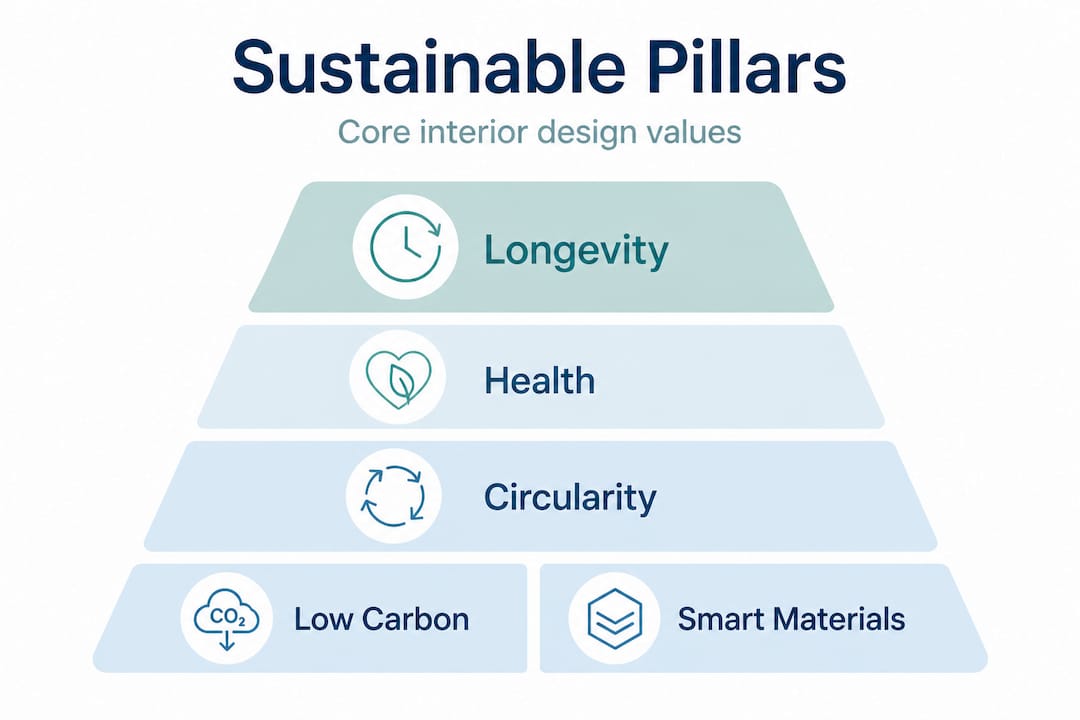
A systems-based approach treats a home as an interconnected whole and optimizes across overlapping goals: lower carbon, healthier indoor environments, and better resource use including waste reduction and circular practices. This is very different from picking one “sustainable” product and calling it done.
The main pillars break down like this:
- Lower environmental impact means reducing energy consumption, minimizing carbon from manufacturing and transport, and choosing materials with smaller ecological footprints.
- Healthy indoor environments focus on materials that do not release volatile organic compounds (VOCs), finishes that support good air quality, and furniture that does not introduce allergens or toxins.
- Efficient resource use prioritizes products that last longer, can be repaired, and can eventually be recycled or repurposed rather than sent to a landfill.
- Circularity in practice means designing or choosing pieces with their end-of-life in mind. Can the sofa frame be reupholstered? Can the shelving be reconfigured?
- Occupant well-being covers thermal comfort, access to natural light, acoustic quality, and biophilic elements like plants and natural textures.
A key tool that professionals use to evaluate these pillars is lifecycle assessment (LCA). LCA is a widely used methodology for quantifying environmental impacts across a product’s stages, from raw material extraction to manufacturing, use, and end-of-life disposal. When you see a product backed by an LCA, it means the environmental claims are based on measured data, not just marketing.
Here is how different material categories tend to score across key sustainability dimensions:
| Material type | Carbon impact | Indoor air quality | Circularity potential | Durability |
|---|---|---|---|---|
| Solid reclaimed wood | Low | High (untreated) | High | Very high |
| New pressed wood | Moderate | Lower (VOCs possible) | Low | Moderate |
| Natural textiles (linen, wool) | Low to moderate | High | High | High |
| Synthetic textiles (polyester) | High | Moderate | Low | Moderate |
| Recycled metal | Low | High | High | Very high |
| Virgin plastic | High | Variable | Low | Variable |
Pro Tip: When evaluating a new piece of furniture, ask the retailer for the material safety data sheet or any third-party certifications. If they cannot provide one, treat that as a signal to look elsewhere.
For practical ideas on working sustainability into a modern home, the urban home sustainability tips on our blog are worth a read.
How to choose sustainable materials and furnishings
Now comes the part most homeowners want: practical steps you can actually use when shopping or updating your space.

Start with what you already own. This is the most overlooked sustainability move. Before you buy anything new, look at what can be maintained, repaired, or refreshed. A scratched wood table can be sanded and refinished. A worn sofa can be reupholstered. Circularity in design aims to keep materials and products in continuous use through reuse, refurbishment, and recycling rather than following a linear take-make-dispose trajectory. Choosing to repair instead of replace is one of the highest-impact decisions you can make.
When you do need to buy new, focus on these factors:
- Non-toxic finishes and adhesives. Look for water-based paints, natural oils, or wax finishes. Avoid formaldehyde-based adhesives common in cheap particleboard.
- Durable construction. Solid wood joints, high thread-count natural fabrics, and metal hardware outlast cheaper alternatives and reduce how often you need to replace items.
- Reclaimed or recycled materials. Reclaimed wood, recycled glass, and repurposed metal reduce demand for virgin resources and often carry more character than new alternatives.
- Local sourcing when possible. Buying furniture made or sourced close to home reduces transportation carbon and supports regional economies.
- Certifications to look for. FSC for wood, OEKO-TEX for textiles, Greenguard Gold for low chemical emissions, and Cradle to Cradle for circularity are reliable third-party indicators.
Our blog post on reusing or upgrading furniture offers specific ideas for refreshing pieces you already love. And if your space is limited, space-saving sustainable furniture can help you do more with less, which is itself a sustainability principle.
Pro Tip: One durable, well-made piece bought once is almost always more sustainable than three budget pieces bought over the same time period. Think cost-per-year, not sticker price.
Circularity also means thinking about disposal before you buy. Ask yourself: when this item reaches the end of its useful life in your home, can it be donated, disassembled, or recycled? If the answer is no, that is worth factoring into your decision.
Verifying sustainability claims: Avoiding greenwashing
Greenwashing is when a company uses vague or misleading language to appear more sustainable than it actually is. It is widespread in the home goods market, and it costs you money while doing little for the environment.
Here is how to spot it and avoid it:
- Watch for single-issue claims. A product labeled “made from recycled materials” may still use toxic dyes, have poor durability, and ship from the other side of the world. One green attribute does not make a product sustainable.
- Question vague language. Words like “natural,” “eco,” “conscious,” or “green” have no legal definition. Ask what specific certification or standard backs up the claim.
- Look for measurable data. Strong sustainability claims are backed by lifecycle assessments, third-party certifications, or detailed ingredient disclosure. Sustainability claims that can be measured and verified rather than treated as marketing language are the ones worth trusting.
- Ask about the full supply chain. A furniture brand that cannot tell you where its wood comes from or what adhesives it uses likely has not done the work to earn a sustainability label.
- Cross-check with established frameworks. Standards like WELL Building Standard for health and air quality, or Cradle to Cradle certification for circularity, require rigorous documentation. These are not easy to fake.
“The difference between a greenwash and a genuine claim is evidence. Any brand serious about sustainability can point you to specific certifications, test results, or lifecycle data.”
Green claims and sustainability are genuinely different things, and a sustainable approach considers broader lifecycle impacts and verifies health and environment claims when possible. That is the standard you should hold suppliers to.
Our post on choosing quality furniture has additional guidance on what to look for beyond sustainability labels, including construction quality and material longevity.
Why starting small has the biggest impact in sustainable design
Here is something that often surprises homeowners: the most impactful sustainable design decisions are rarely the most dramatic ones.
Many people assume that sustainability requires a full renovation, new low-emission appliances, or a complete swap to organic materials throughout the home. In practice, the opposite tends to be true. The most reliable first moves for homeowners are often to keep and maintain what you already have, buy fewer and higher-durability items, and prioritize low-emissions finishes.
Think about it this way. Manufacturing new furniture, even the most responsibly sourced piece, requires energy, water, and raw materials. Every time you avoid a new purchase by maintaining what you own, you eliminate that entire production footprint. The compound effect of making fewer, better choices over a decade far outweighs the benefit of any single green product swap.
This also changes how you should think about upgrading your home. Instead of a seasonal refresh where you swap out decor for trends, focus on upgrading versus replacing furniture strategically. Invest in pieces that age well, repair rather than discard, and layer in sustainable improvements gradually.
The three metrics that matter most for long-term sustainability in your home are durability (how long will this last?), indoor health (does this improve or harm the air you breathe?), and purchase frequency (are you buying less over time?). These are more meaningful than any label on a product box. Sustainable design is not a shopping list. It is a mindset that gets sharper and more effective the longer you apply it.
Design your sustainable home with New Way Ref
Ready to put these principles into practice in your own space? At New Way Ref, we curate furniture and decor that aligns with the values you have read about here: durability, thoughtful design, and products that earn their place in your home.
Whether you are looking for a sturdy coffee table built to last, a shoe cabinet that keeps clutter at bay, or lighting that transforms the feel of a room, our collection is chosen with quality and longevity in mind. You can shop sustainable home essentials directly from our store, with free shipping on orders over $50. For additional eco-conscious home solutions, explore our extended range at browse eco-friendly home solutions. Your next thoughtful upgrade is just a few clicks away.
Frequently asked questions
What is the main goal of sustainable interior design?
The main goal is to minimize environmental harm and support healthy indoor living by considering the entire lifecycle of materials and products used in a space.
How does sustainable design differ from green design?
Sustainable design considers broader lifecycle impacts, carbon footprint, and occupant health, while green design often targets only one specific eco-attribute without a full-picture view.
What is lifecycle assessment in interior design?
LCA quantifies environmental impacts across all of a product’s stages, from raw material extraction through manufacturing, use, and disposal, helping you make smarter material choices.
What are some easy first steps for sustainable interiors?
Maintain and repair what you own, buy fewer but higher-quality items, and select low-emission, non-toxic finishes. These first moves for homeowners consistently deliver the biggest long-term impact.
How can I avoid greenwashing when shopping for my home?
Look for third-party certifications, ask for lifecycle data, and be skeptical of vague terms like “natural” or “eco.” Verified sustainability claims are backed by measurable standards, not just marketing language.