

TL;DR:
- Mirrors enhance interior lighting by reflecting natural and artificial light to create a brighter, more spacious environment. Proper placement of large mirrors opposite windows or near light fixtures enhances space perception and light distribution. Choosing the right size, style, and placement of mirrors can significantly boost a room’s visual appeal and ambiance.
Mirrors are defined in interior design as reflective surfaces that amplify light, expand perceived space, and act as dynamic decor elements. The role of mirrors in interiors goes far beyond a place to check your reflection. A well-placed mirror can make a cramped studio feel like a loft, redirect sunlight into a dark hallway, and give a plain wall genuine visual weight. Designers at firms like Kern & Co. and publications like House & Garden have long treated mirrors as one of the most cost-effective tools in a decorator’s kit. This guide gives you the practical knowledge to use them the same way.
How do mirrors enhance natural and artificial lighting in rooms?
Mirrors amplify both natural and artificial light, creating more uniform, layered illumination that elevates ambiance even in rooms with limited windows. That means a single well-placed mirror can do the work of an extra light fixture without any electrical work.
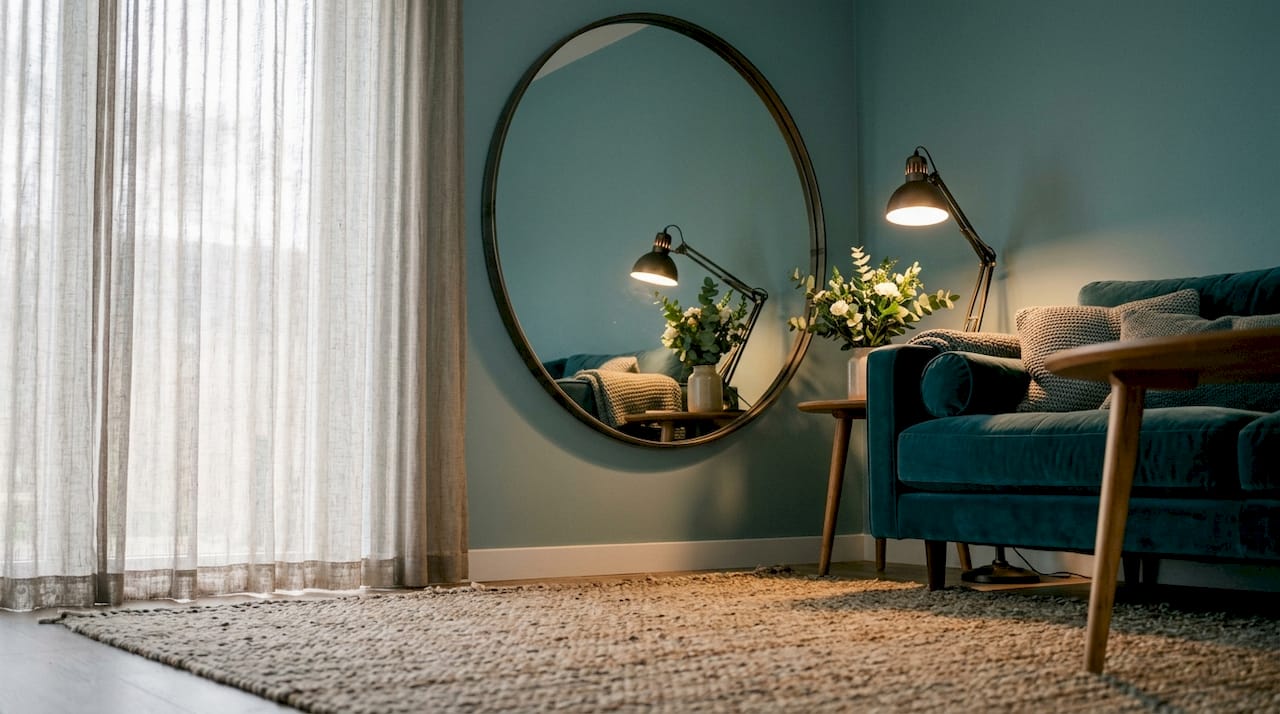
The most reliable placement strategy is positioning a large mirror directly opposite a window. This creates what designers call a “second window” effect. The mirror catches incoming sunlight and scatters it across the room, reducing dark corners and making the space feel open at any time of day. Kern & Co. notes that placing mirrors opposite windows can double the perceived size of a room by extending sightlines and views, which is especially useful in narrow hallways and small urban apartments.
Artificial lighting works the same way. Mirrors placed near chandeliers, sconces, or pendant lights redistribute that glow into shadowed areas. The result is consistent brightness without adding more fixtures. Layered lighting strategies combined with mirror placement produce consistent brightness and improved ambiance, outperforming single-source illumination in both function and visual appeal.
Here are the lighting types that work best with mirrors:
- Chandeliers: A mirror placed on the wall behind or beside a chandelier multiplies the fixture’s sparkle and fills the ceiling zone with reflected light.
- Wall sconces: Flanking a mirror with sconces creates a symmetrical glow that reads as intentional and polished.
- Recessed downlights: Angling a mirror to catch recessed light pulls brightness down from the ceiling into eye-level spaces.
- Floor lamps: A tall mirror beside a floor lamp doubles the warm pool of light and makes a reading corner feel larger.
Pro Tip: For small spaces with no natural light, pair a mirror with a warm-toned LED sconce on an adjacent wall. The combination mimics the effect of a window and adds depth without any structural changes. Newwayref’s guide on lighting for small spaces covers this pairing in detail.
What are the best mirror sizes and placements for different rooms?
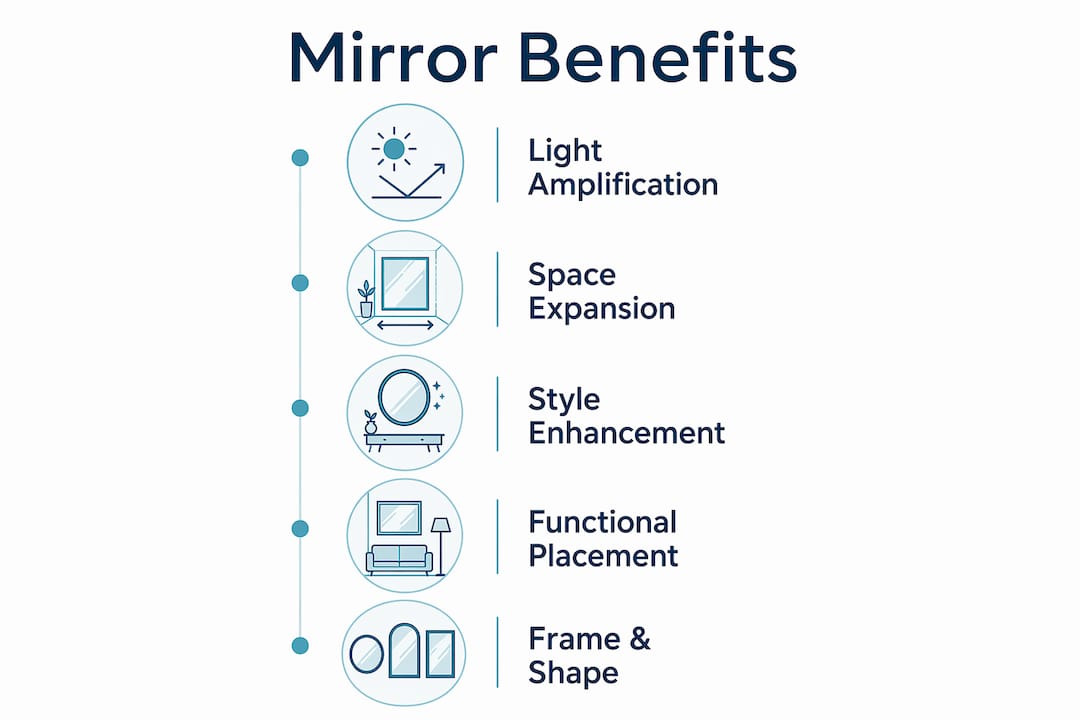
Mirror size and placement are the two variables that determine whether a mirror helps or hurts a room. Get both right and the effect is immediate.
Larger mirrors are recommended in small, cramped rooms because they take up more wall space and expand the perceived visual footprint far better than smaller mirrors or fragmented art. A single oversized mirror reads as a design statement. A cluster of small mirrors reads as clutter. Country Living’s design editors also note that incorrectly sized mirrors fall short just like incorrectly sized artwork. Bigger pieces create a stronger sense of space than small, high-hung items.
Mirrors are also used beyond walls. Antiqued mirror panels on ceilings and mirrored kitchen backsplashes amplify light and overcome architectural limitations. A mirrored backsplash in a galley kitchen, for example, visually doubles the counter depth and bounces overhead lighting downward onto the work surface.
| Room | Recommended mirror type | Ideal placement |
|---|---|---|
| Entryway | Full-length or large rectangular | Opposite the front door or on a narrow side wall |
| Living room | Oversized statement or panel mirror | Above the sofa or fireplace, opposite a window |
| Hallway | Tall vertical or series of panel mirrors | Along the longest wall to extend sightlines |
| Kitchen | Mirrored backsplash or small framed mirror | Behind the stove or above the sink |
| Bedroom | Full-length leaner or built-in wardrobe mirror | On a closet door or angled wall, not facing the bed directly |
Designers consistently advise against covering an entire wall with mirror. That approach can feel clinical rather than warm. The goal is sizeable but balanced placement that enhances the room without overwhelming it.
Pro Tip: In an entryway, mirrors serve a dual purpose. They let guests check their appearance on the way out and create openness in narrow foyers at a fraction of the cost of architectural renovation. A framed mirror hung at eye level on the narrowest wall is the single highest-return design move in any foyer.
How can mirrors contribute to style beyond space and light?
Mirrors are dynamic design pieces, not static decor. A mirror reflecting a beautiful view or a piece of art doubles its visual appeal. A mirror reflecting a cluttered corner multiplies the negative. That interactivity makes mirror placement a genuine design decision, not just a practical one.
Frame style is the fastest way to shift a mirror’s decorative impact. A thin black metal frame reads as modern and minimal. A wide carved wood frame reads as traditional and warm. A frameless mirror reads as architectural. Each choice sends a different signal about the room’s overall style.
Shape matters just as much as frame. Round mirrors soften rooms with lots of straight lines and right angles. Arched mirrors add height and a sense of grandeur. Irregular or sunburst shapes work as focal points on gallery walls. Rectangular mirrors are the most versatile and work in nearly every room type.
Antique and gilt mirrors add gravitas and patina to contemporary interiors. They ground modern designs and prevent the sterility that can come from all-new furnishings. House & Garden’s design editors describe antique mirrors as providing a balance between style and function, adding a sense of history and depth without sacrificing light benefits. Pairing a gilt mirror with a clean-lined sofa is one of the most reliable ways to add character to a modern living room.
Here are the key stylistic roles mirrors play in home decor:
- Focal point: A large, ornate mirror above a fireplace anchors the room and draws the eye.
- Art substitute: A mirror with a decorative frame fills wall space with the same visual weight as a painting, but adds light instead of absorbing it.
- Color amplifier: A mirror placed near a colorful rug or accent wall reflects that color back into the room, intensifying the palette.
- Texture contrast: A raw-edge or antiqued mirror introduces texture and age into rooms dominated by smooth, modern surfaces.
For more ideas on weaving mirrors into a modern aesthetic, Newwayref’s guide on modern home decor ideas covers current style directions in detail.
What are common mistakes to avoid when using mirrors?
The most common mirror mistake is placing one without thinking about what it reflects. A mirror facing a blank wall doubles the blankness. A mirror facing a cluttered bookshelf doubles the disorder. Before you hang anything, stand where the mirror will go and look at what it will show. That reflection is what every person in the room will see.
Here are the most frequent errors and how to fix them:
- Hanging mirrors too high. Eye-level placement works best for most rooms. A mirror hung near the ceiling reflects the ceiling, not the room. Drop it to where a person of average height sees their face in the center.
- Using too many mirrors. One or two well-chosen mirrors create depth. Five or six create visual confusion. Limit mirrors to one per wall in most rooms.
- Ignoring proportions. A small mirror on a large wall looks lost. Match the mirror’s width to at least half the width of the furniture below it.
- Skipping layered lighting. A mirror in a dark room reflects darkness. Combine mirror placement with layered lighting strategies for the best result. Kevin Francis Design’s guide on designer lighting types explains how different fixture types interact with reflective surfaces.
- Placing mirrors directly facing the bed. Many designers avoid this placement because it can feel unsettling. Position bedroom mirrors on closet doors or side walls instead.
Pro Tip: Before committing to a permanent installation, lean the mirror against the wall and live with it for a day or two. Walk past it at different times of day and in different lighting conditions. What it reflects at noon is very different from what it reflects at 8 p.m.
Key takeaways
Mirrors are the most cost-effective tool in interior design, delivering light amplification, space expansion, and style in a single piece when placed with intention.
| Point | Details |
|---|---|
| Placement drives results | Position mirrors opposite windows or near light sources to maximize brightness and perceived space. |
| Size matters more than quantity | One large mirror outperforms several small ones in both spatial and aesthetic impact. |
| Reflect something worth seeing | Always check what a mirror will show before hanging it. Reflecting art or views adds value; reflecting clutter subtracts it. |
| Frame style sets the tone | Choose frame material and shape to match your room’s style, from gilt antique to frameless modern. |
| Combine mirrors with layered lighting | Mirrors alone cannot fix a dark room. Pair them with sconces, pendants, or floor lamps for consistent brightness. |
Why I think most people underestimate what a mirror actually does
Most people buy a mirror for one reason: they need to see themselves. That is the wrong starting point for interior design. The mirrors that make the biggest difference in a home are the ones placed with zero regard for personal grooming and total regard for how light moves through a room.
I have seen narrow hallways that felt like tunnels until a single floor-to-ceiling mirror was leaned against the end wall. The hallway did not get wider. The light did not change. But the space felt twice as long and half as oppressive. That is the power of a well-placed reflective surface, and it costs less than a new sofa.
The other thing most people miss is the mood dimension. A warm-toned antique mirror in a modern room does not just add style. It adds a sense of time and permanence that new furniture cannot replicate. A room full of brand-new pieces can feel like a showroom. One aged mirror with a gilt frame makes it feel lived in. That shift in feeling is real, and it matters more than most design choices.
My honest advice: treat your mirrors the way you treat your windows. Think about what they face, what they let in, and what they show the room. A mirror is not decoration. It is an active participant in how your space looks and feels every single day.
— Enn
Newwayref has mirrors and decor to complete your space
Finding mirrors that balance function and style in one piece is easier than it used to be. Newwayref carries a thoughtfully curated selection of home decor and furniture designed for modern living spaces, from statement mirrors to lighting fixtures that pair perfectly with reflective surfaces.
Whether you are updating a narrow entryway, refreshing a living room wall, or pulling together a bedroom redesign, Newwayref’s full collection offers practical options at accessible price points. Free shipping on orders over $50 makes it easy to add a mirror and a complementary piece in the same order. Browse the current selection and find the mirror that fits your space.
FAQ
What is the main role of mirrors in interior design?
Mirrors amplify natural and artificial light, expand the perceived size of a room, and serve as decorative focal points. Their primary function in interior design is to improve both the brightness and the visual scale of a space.
Where is the best place to hang a mirror in a room?
The most effective placement is directly opposite a window, which reflects incoming light and extends sightlines. Entryways, living rooms above fireplaces, and hallways along the longest wall are the top locations recommended by designers.
Can mirrors make a small room look bigger?
Yes. Large mirrors in small rooms expand the perceived visual footprint more effectively than smaller mirrors or fragmented art. A single oversized mirror opposite a window is the most reliable method.
What mirror frame style works best for modern interiors?
Thin black metal frames, frameless mirrors, and clean-lined wood frames suit modern interiors best. Antique and gilt frames work well as contrast pieces, adding warmth and character to rooms with contemporary furniture.
How do mirrors interact with artificial lighting?
Mirrors placed near chandeliers, sconces, or pendant lights redistribute artificial light into shadowed areas. Combining mirror placement with layered lighting produces more consistent brightness than relying on a single light source alone.