

TL;DR:
- Mid-century modern is a design movement from the 1940s to the late 1960s characterized by clean lines, organic forms, and a focus on the unity of beauty and function. It emphasizes honest materials, tapered legs, and integration with nature, reflecting post-war social and manufacturing advancements. Incorporating authentic or reproduction pieces, balanced with a thoughtful approach, allows modern homes to embrace its timeless, versatile appeal.
Mid-century modern is defined as a design movement from the 1940s through the late 1960s, built on clean lines, organic forms, and the principle that beauty and function are inseparable. The term itself was popularized by Cara Greenberg in her 1984 book Mid-Century Modern: Furniture of the 1950s, giving a name to a movement already decades in the making. Designers like Charles and Ray Eames, Eero Saarinen, and Hans Wegner defined the aesthetic through furniture and architecture that felt both sculptural and livable. If you want to understand what defines mid-century modern style and how to recognize it in a room, this guide covers everything from its origins to how you can use it in your home today.
What is mid-century modern design?
Mid-century modern design is a specific historical movement, not a general descriptor for anything that looks old or retro. Its primary period runs from the 1940s to the late 1960s, though historians trace its roots back to the early 1930s and its influence forward into the 1970s. The style rejects excess. There is no carved woodwork, no heavy drapery, no gilded ornamentation. Instead, every element of a piece serves a purpose.
The philosophy behind the movement is often summarized as “form follows function,” a principle borrowed directly from the Bauhaus school in Germany and reinforced by Scandinavian design traditions. This means the shape of an object is determined by what it needs to do, not by how decorative it can appear. A chair should support the body comfortably. A table should hold objects at a useful height. The visual appeal comes from how well those functions are expressed through honest materials and considered proportions.
What makes mid-century modern design immediately recognizable is the combination of geometric precision and organic softness. You will see straight lines alongside curved edges, flat surfaces paired with sculptural legs, and natural wood grains left visible rather than painted over. This is not minimalism for its own sake. It is design that respects both the material and the person using it.
What are the defining characteristics of mid-century modern?
The characteristics of mid-century modern design fall into several consistent patterns that appear across furniture, architecture, and interiors.
- Clean, uncluttered lines. Silhouettes are simple and intentional. Sofas sit low to the ground. Shelving units are open and geometric. Nothing is added without reason.
- Natural and industrial materials. Teak, walnut, molded plywood, fiberglass, and steel are the signature materials. Designers used them to highlight structure rather than hide it. Wood grain is celebrated, not stained into uniformity.
- Tapered legs and balanced proportions. Tapered legs and intentional proportions are one of the most recognizable visual signatures of the style. They give furniture a sense of lightness and lift, making even a heavy sofa appear to float above the floor.
- Integration with nature. Large windows, open floor plans, and the use of natural light are architectural hallmarks. The goal is to blur the boundary between interior space and the outdoors.
- Warm, grounded color palettes. Whites, warm browns, walnut tones, and muted earth shades form the base. Bold accent colors, think mustard yellow, olive green, or burnt orange, appear in upholstery, rugs, or artwork rather than on walls.
- Minimal ornamentation. Joinery is often left visible. Material grain is treated as decoration in itself. There are no applied moldings or decorative carvings.
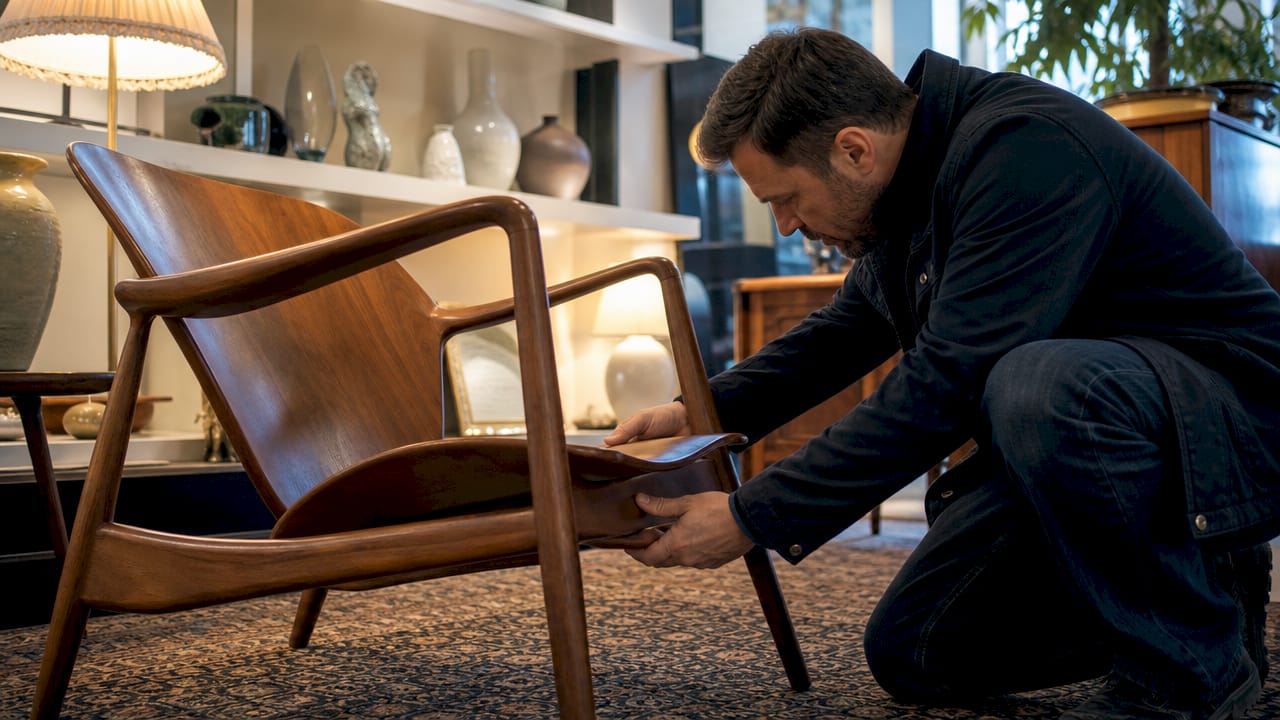
Pro Tip: When identifying mid-century modern furniture in a store or at an estate sale, flip the piece over. Authentic construction from the period often shows visible joinery, labeled hardware from manufacturers like Herman Miller or Knoll, and wood grain that matches across surfaces.
The influence of new manufacturing technologies is impossible to separate from the style. Molded plywood, developed partly through wartime research by Charles and Ray Eames for the U.S. Navy, became a signature material precisely because it could be shaped into organic curves that solid wood could not achieve at scale. Technology did not compromise the aesthetic. It made it possible.
How did history shape mid-century modern style?
The history of mid-century modern design is inseparable from the social and economic conditions of post-World War II America and Europe. The war ended in 1945 with a surge of optimism, a housing boom, and a generation of young families who needed well-designed, affordable furniture for new suburban homes. Post-war optimism and mass production created the exact conditions the movement needed to thrive.
The cultural forces that shaped the movement developed in this order:
- Bauhaus influence. The German Bauhaus school, active from 1919 to 1933, established the foundational belief that art, craft, and industrial production should work together. When the Nazis closed the school, many of its faculty emigrated to the United States, bringing those ideas directly into American design education.
- Scandinavian modern design. Danish and Swedish designers like Hans Wegner and Alvar Aalto were already producing furniture that combined natural materials with functional simplicity. Their work gave mid-century modern its warmth and its respect for craftsmanship.
- Post-war manufacturing capacity. Factories retooled after the war could produce furniture at scale using new materials and techniques. Charles and Ray Eames and Eero Saarinen worked directly with manufacturers like Herman Miller and Knoll to bring designs from prototype to mass production.
- Rejection of ornate historicism. The heavy Victorian and Edwardian styles that preceded mid-century modern felt out of step with a society focused on rebuilding and moving forward. The new aesthetic was a deliberate break from the past.
- Democratic design philosophy. Functional design accessible to all, not just the wealthy, was a core belief. The goal was to produce beautiful, well-made objects that a middle-class family could actually afford and live with.
This combination of philosophy, technology, and cultural moment explains why the style spread so quickly and why it has never fully gone out of fashion.
How does mid-century modern differ from vintage, retro, and contemporary?
This is where most people get confused, and the distinctions matter if you want to shop or decorate with accuracy.
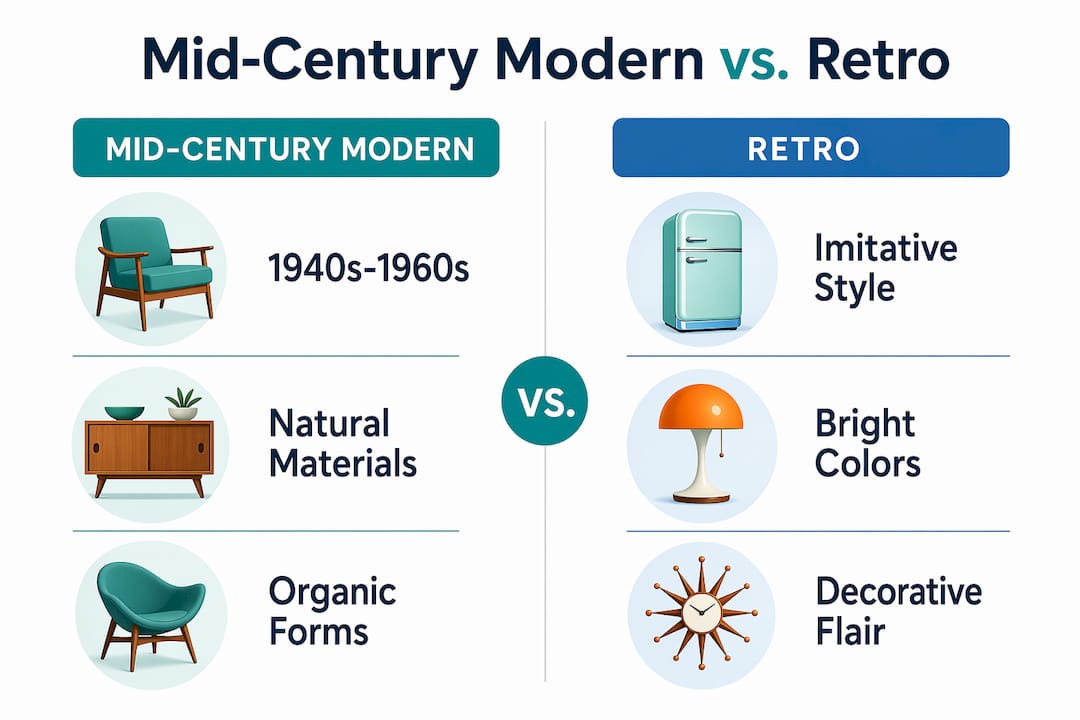
Vintage, retro, and mid-century modern are not interchangeable terms. Vintage refers to the age of an object, typically anything over 20 years old. Retro describes a style that imitates the look of a past era without being from that era. Mid-century modern is a specific design philosophy and historical movement with defined characteristics, regardless of when a piece was made.
| Style | Time frame | Materials | Color palette | Key distinction |
|---|---|---|---|---|
| Mid-century modern | 1940s to 1960s | Teak, walnut, plywood, fiberglass | Warm woods, earth tones, bold accents | Defined design philosophy, form follows function |
| Contemporary modern | 1990s to present | Concrete, glass, pale woods, metal | Cool grays, whites, black | Cooler and more minimalist, less organic warmth |
| Retro | Any era | Varies | Often bright, kitschy | Style imitation, not historical authenticity |
| Vintage | 20+ years old | Varies | Varies | Age-based classification, not style-based |
Contemporary modern design uses cooler palettes, concrete, glass, and pale woods, while mid-century modern favors warmer tones and organic shapes. The two styles are compatible and often mixed successfully, but they are not the same thing. A room that blends a walnut Eames lounge chair with a concrete-topped coffee table is mixing styles intentionally. Calling that room purely mid-century modern would be inaccurate.
One common misconception is that mid-century modern feels cold or sterile. That confusion likely comes from conflating it with minimalist contemporary design. In practice, the warm wood tones, textured upholstery, and organic curves of authentic mid-century modern pieces create spaces that feel grounded and inviting rather than sparse.
How to incorporate mid-century modern into your home today
Bringing mid-century modern style into your home does not require sourcing original 1950s pieces or committing to a single rigid aesthetic. Mixing authentic vintage pieces with modern furniture is not only acceptable, it is encouraged. The style is defined by principles, not by provenance.
Here is how to apply those principles practically:
- Start with furniture silhouettes. Look for sofas and chairs with low profiles, tapered legs, and clean lines. A walnut-framed sofa with a low back and tight cushions reads as mid-century modern immediately, regardless of when it was made.
- Choose warm wood tones. Teak and walnut are the signature woods. If you are working with a tighter budget, look for pieces with walnut veneer or warm-stained oak. Avoid cool-toned gray or white-washed woods, which push the room toward contemporary rather than mid-century.
- Use natural light intentionally. Open up window treatments or remove heavy curtains. Mid-century modern interiors are designed around light and the connection to the outdoors. Sheer panels or simple roller shades work better than layered drapes.
- Select lighting that fits the era. Sputnik chandeliers, arc floor lamps, and globe pendants are all period-appropriate choices. For guidance on pairing fixtures with your space, modern home lighting principles apply directly to mid-century rooms. You can also explore 2026 lighting trends for contemporary takes on classic silhouettes.
- Add bold accents deliberately. A mustard yellow throw pillow, an olive green accent chair, or a burnt orange ceramic lamp base introduces color without overwhelming the neutral base. Keep bold color to 10 to 15 percent of the visual field.
- Avoid clutter. Mid-century modern interiors breathe. If every surface is covered, the design language is lost. Edit your accessories down to a few intentional objects, a ceramic vase, a sculptural lamp, a single piece of graphic art.
Pro Tip: If you want to create a mid-century modern bedroom without a full renovation, start with a platform bed frame in walnut or teak finish, add a pair of cone-shaped bedside lamps, and use a geometric wool rug in earth tones. Those three elements alone shift the room’s character significantly. For more ideas, mid-century modern bedroom inspiration can help you refine the look.
What are the advantages and limitations of mid-century modern homes?
Mid-century modern design has genuine strengths and real trade-offs. Understanding both helps you make informed decisions about how far to commit to the style.
Strengths:
- Timeless visual appeal. The style has remained desirable for over 70 years. It does not date the way trend-driven styles do.
- Versatility. Mid-century modern pieces mix well with contemporary furniture and Scandinavian design without losing their character.
- Collectibility. Authentic pieces by Charles and Ray Eames, Eero Saarinen, or Hans Wegner hold and often increase in value. Original construction and provenance are what collectors prioritize.
- Functional comfort. The style was designed for everyday living, not showrooms. The furniture is meant to be used.
Limitations:
- Energy efficiency. Large windows in mid-century modern homes can reduce energy efficiency and increase heating and cooling costs. This is a real consideration for homeowners, not just an aesthetic one.
- Sourcing authentic pieces. Original mid-century modern furniture is increasingly rare and expensive. Quality reproductions are widely available but carry no historical value.
- Maintenance of natural materials. Teak and walnut require periodic oiling and care to maintain their appearance. They are not low-maintenance materials.
Key takeaways
Mid-century modern is a defined design philosophy rooted in functional simplicity, natural materials, and organic form, originating between the 1940s and 1960s and remaining one of the most versatile and enduring styles in residential design.
| Point | Details |
|---|---|
| Clear historical definition | Mid-century modern spans the 1940s to late 1960s and is not interchangeable with vintage or retro. |
| Signature materials and forms | Teak, walnut, molded plywood, tapered legs, and organic shapes define the visual language. |
| Philosophy over provenance | Mixing authentic pieces with quality reproductions is acceptable; the principles matter more than the age. |
| Distinct from contemporary | Mid-century modern uses warmer tones and organic shapes; contemporary design favors cooler, more minimal palettes. |
| Real trade-offs exist | Large windows and natural materials bring beauty but also energy and maintenance considerations. |
Why mid-century modern still earns its place in your home
I have spent years watching design trends cycle through living rooms, and most of them age badly within a decade. Mid-century modern does not. The reason is not nostalgia. It is that the style was built on a problem-solving philosophy rather than a visual trend. When Charles and Ray Eames designed the Eames Lounge Chair in 1956, they were solving for comfort, material honesty, and producibility at scale. The fact that it still looks right in a 2026 living room is a byproduct of that thinking, not the goal.
What I see most often when people attempt the style is an overcommitment to the visual clichés. They buy the Sputnik chandelier, the walnut credenza, and the tulip table, then wonder why the room feels like a set rather than a home. The style works when you apply the underlying principles: respect for materials, restraint in decoration, and furniture that actually fits how you live. A single well-chosen walnut coffee table does more for a room than a full catalog of period-correct accessories.
The other mistake is treating mid-century modern as a sealed category. It was never meant to be. The designers who created it were mixing influences from Bauhaus, Scandinavia, Japan, and American industrial production simultaneously. Your room can do the same. Pair a mid-century sofa with a contemporary floor lamp. Use a vintage teak sideboard alongside a modern sectional. The style is flexible enough to absorb those combinations without losing its identity, as long as the core principles of clean form, honest materials, and functional purpose remain visible.
— Enn
Bring mid-century modern style into your home with Newwayref

Newwayref carries a thoughtfully curated selection of furniture and decor that reflects the principles of mid-century modern design: clean silhouettes, warm wood finishes, and pieces built for everyday living. Whether you are furnishing a living room from scratch or adding a few well-chosen accents, you will find options that fit the aesthetic without requiring a vintage dealer or an auction house. Browse coffee tables with tapered legs, lighting fixtures with period-appropriate profiles, and home decor that complements warm wood tones. Visit Newwayref to explore the full collection and find pieces that work for your space and your budget.
FAQ
What is the mid-century modern time period?
Mid-century modern covers the period from the 1940s to the late 1960s, with some historians extending the range from 1933 to the early 1970s. The peak of the movement falls squarely in the 1950s and early 1960s.
How do I identify mid-century modern furniture?
Look for tapered legs, low profiles, warm wood tones like teak or walnut, and minimal ornamentation. Visible joinery and organic or geometric shapes are also reliable indicators of the style.
Is mid-century modern the same as retro?
No. Retro describes a style that imitates the look of a past era without being from it. Mid-century modern is a specific historical design movement with a defined philosophy, not simply an aesthetic imitation of the past.
Can mid-century modern work in a small space?
Yes. The style’s emphasis on clean lines, open floor plans, and furniture with visual lightness, such as pieces with tapered legs, makes it well-suited to smaller rooms. For more ideas, modern decor for small spaces offers practical guidance.
Are mid-century modern reproductions worth buying?
Reproductions provide the visual appeal of the style without the cost or rarity of original pieces. They carry no collectible value, but for most homeowners focused on aesthetics rather than investment, a quality reproduction is a practical and sensible choice.