

TL;DR:
- Strategic furniture placement enhances room functionality, comfort, and visual appeal by optimizing space and flow. Proper layout reduces stress and subconscious tension, creating calm, legible environments that support daily activities and social comfort. Adjusting furniture based on traffic patterns and psychological principles transforms rooms into spaces that genuinely serve how you live.
Furniture arrangement is the intentional placement of furniture to optimize space utilization, traffic flow, comfort, and visual appeal in your home. Professionals call this practice spatial planning or interior layout design, and it goes far beyond simply fitting pieces into a room. When you arrange furniture strategically, you control how a room feels, how people move through it, and how much stress or ease the space creates. The difference between a room that works and one that frustrates you daily often comes down to a few deliberate placement decisions.
Why arrange furniture strategically: the case for spatial planning
The core reason to arrange furniture strategically is that placement directly controls how usable your space is. A sofa pushed against the wall might seem like it saves space, but it often creates an awkward, disconnected seating area that discourages conversation and makes the room feel like a waiting room. Spatial planning treats your floor plan as a functional system, not just a backdrop for furniture.
Good layout starts with traffic flow. Industry standards call for at least 30 to 36 inches of clearance on primary walking routes, and up to 44 inches behind seated diners so people can push back chairs and move freely. These numbers exist because anything narrower creates friction. You start turning sideways to pass, guests hesitate before walking through, and the room feels smaller than it actually is.
Here is a practical sequence for evaluating your current layout:
- Stand at every entry point and trace the natural path to the most-used seat or surface.
- Check whether any furniture leg, corner, or edge interrupts that path within the first three steps.
- Measure the clearance behind your dining chairs when they are pulled out.
- Identify whether your sofa or bed forces a detour around it rather than a direct route.
- Note any door or window that furniture partially blocks, reducing light or access.
Common mistakes include placing a console table directly behind a sofa that floats in the room, leaving only 12 inches of clearance, or positioning an armchair so it blocks the path from the hallway to the kitchen. Both create what environmental designers call “obstacle fatigue,” where the brain registers repeated small interruptions as low-level stress.
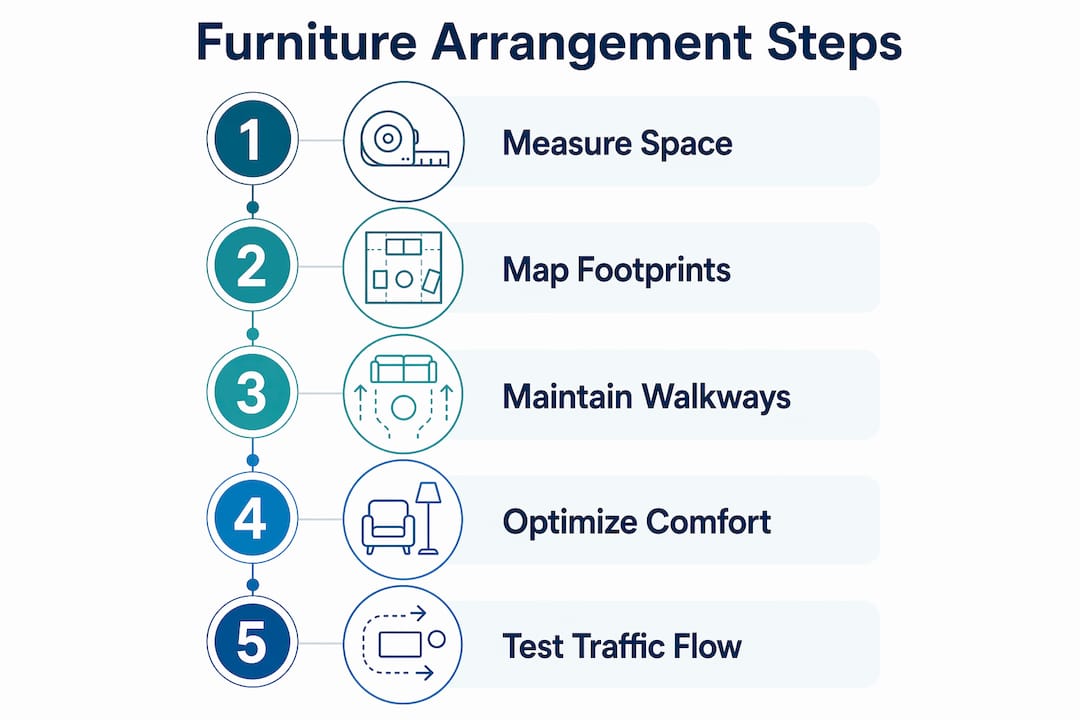
Pro Tip: Before moving a single piece of furniture, use painter’s tape to map furniture footprints on the floor. This lets you test clearances, visualize zones, and catch problems before your back pays the price.
How does furniture layout affect your mood and comfort?
Furniture layout functions as an invisible script for your brain, lowering cognitive load and reducing anxiety when the arrangement is clear and logical. This is not abstract theory. Environmental psychology research shows that organized layouts reduce subconscious tension by minimizing obstacles and improving what researchers call “environmental legibility,” meaning your brain can read the room instantly without effort.

One of the most practical concepts from architectural psychology is prospect and refuge. The idea is that the best seating position has a solid backing, like a wall or tall bookcase behind it, and a clear view of the room or entry point. This mirrors how humans instinctively chose safe resting spots for thousands of years. A chair facing a blank wall with its back exposed to foot traffic will always feel slightly uncomfortable, even if you cannot name why.
Social distance also matters more than most people realize. Proxemics research identifies 2.4 to 3.0 meters as the comfortable range for conversation between people who are not close friends or family. Seating arranged beyond that distance starts to feel cold and disconnected. Seating pushed too close feels intrusive. Most living rooms default to one of these extremes without the homeowner ever noticing.
“Rooms that feel calm manage a balance of coherence, legibility, complexity, and mystery in their layouts and furnishings.” — Studio Matrx
The practical takeaway is this: if your living room feels vaguely uncomfortable even after you have decorated it well, the layout is likely the cause. Rearranging furniture to create a clear anchor seat, a logical traffic path, and appropriate conversational distance costs nothing and can change how the room feels within an afternoon.
Practical tips on how to arrange furniture effectively
The most reliable approach to arranging furniture effectively starts with the largest piece in the room. In a living room, that is the sofa. In a bedroom, it is the bed. Place the anchor piece first, oriented toward the room’s focal point, whether that is a fireplace, a window, or a media unit. Every other piece then responds to that anchor.
Here are the core furniture placement tips that apply across most rooms:
- Start with the focal point. Orient your largest seating piece toward the room’s natural center of attention. This creates visual order immediately.
- Keep the coffee table at the right distance. A coffee table positioned 14 to 18 inches from the sofa edge is reachable without leaning and does not crowd legroom.
- Use rugs to define zones. An area rug works best when it covers two-thirds of the floor space or has the front legs of all major seating pieces resting on it. A rug that is too small floats in the center and makes the room feel unanchored.
- Float furniture away from walls. Pulling pieces a few inches inward creates visual depth and improves conversation. For guidance on using rugs to anchor zones, the right rug size makes floating furniture look intentional rather than awkward.
- Separate functional zones clearly. In open-plan spaces, use a sofa back or a console table to signal where the living area ends and the dining area begins.
| Furniture piece | Recommended spacing |
|---|---|
| Coffee table to sofa | 14 to 18 inches |
| Primary walkway clearance | 30 to 36 inches |
| Dining chair clearance (pulled out) | 44 inches behind seat |
| Seating distance for conversation | 8 to 10 feet (2.4 to 3.0 meters) |
| Rug coverage | Two-thirds of floor space or front legs on rug |
Avoid the temptation to fill every corner with a small accent chair or side table. Fewer, well-proportioned pieces create a room that reads as spacious and considered. Too many small pieces fragment the eye and make the space feel cluttered regardless of how tidy it is.
Common furniture arrangement mistakes and how to fix them
The most common layout mistakes are ignoring walkways, overbuying furniture, and using rugs that are too small. Each one is fixable, but you need to recognize it first.
- Pushing everything to the walls. This is the most widespread mistake in living rooms. It creates a large dead zone in the center and forces seating so far apart that conversation becomes difficult. Pull pieces inward and let the center breathe.
- Buying furniture without measuring. A sectional that looked reasonable in a showroom can consume 70 percent of a small living room’s floor space. Always measure your room and sketch the footprint before purchasing.
- Blocking natural light. A tall bookcase or armoire placed in front of a window cuts off daylight and makes the room feel heavier. Position tall pieces on walls without windows whenever possible.
- Overcrowding with small pieces. Three small accent chairs do not replace one well-sized sofa. They add visual noise and reduce usable floor space. Consolidate where you can.
- Ignoring natural traffic paths. Every room has a desire line, the path people naturally walk when moving from one point to another. Placing furniture across that line creates daily friction.
Pro Tip: Walk through your room at your busiest moment, such as when cooking, hosting, or getting ready in the morning. If the layout holds up under real use, it works. If you are constantly sidestepping furniture, something needs to move.
For smaller spaces, the challenge is especially real. Practical guidance on furniture for small spaces can help you choose pieces that serve multiple functions without crowding the room.
Key takeaways
Strategic furniture arrangement improves how a room functions, feels, and flows by applying clear spatial standards, psychological principles, and proportional placement decisions.
| Point | Details |
|---|---|
| Traffic flow standards | Maintain 30 to 36 inches on walkways and 44 inches behind dining chairs for comfortable movement. |
| Psychological comfort | Place anchor seating with solid backing and a clear view to reduce subconscious anxiety. |
| Spacing guidelines | Keep coffee tables 14 to 18 inches from the sofa and seating within 10 feet for natural conversation. |
| Rug placement | Cover two-thirds of the floor or place front furniture legs on the rug to anchor the zone. |
| Avoid common mistakes | Pull furniture off walls, measure before buying, and keep traffic paths clear of obstacles. |
What I have learned from rearranging rooms that felt wrong
Most people redecorate when a room feels off. They buy new cushions, repaint a wall, or add a lamp. In my experience, the room still feels wrong because the furniture layout was never addressed. Decoration sits on top of layout. If the foundation is broken, no amount of styling fixes it.
The test I always recommend is what some designers call the busiest moment test. Sit in the room during its most active period, whether that is a family dinner, a gathering with friends, or just a busy weekday morning. If the room stays calm and movement feels natural, the layout works. If people keep bumping into things or gravitating to one corner while the rest of the room sits unused, the arrangement is telling you something.
I also think most homeowners underestimate how much layout shapes their daily mood. A bedroom where you have to walk around the foot of the bed every morning to reach the closet adds a small irritation to your day, every day. A living room where the sofa faces away from the window means you never get the benefit of that natural light. These are not decorating problems. They are layout problems, and they are worth solving before anything else.
Treat your furniture arrangement as a living system. Test it, adjust it, and revisit it when your life changes. A layout that worked when you worked from an office may not work now that you work from home. The room should serve how you actually live, not how you imagined you would live when you first moved in.
— Enn
Transform your space with Newwayref
Getting your layout right is the first step. Having the right furniture to work with is the second. Newwayref offers a thoughtfully curated selection of sofas, coffee tables, rugs, and home accessories designed to fit modern living spaces without overwhelming them. Whether you are working with a compact apartment or a larger open-plan home, the right pieces make spatial planning significantly easier. Explore the full collection at Newwayref and find furniture that supports the layout you are building, not one that fights it. Free shipping on orders over $50 makes it practical to start today.
FAQ
Why is furniture layout more important than decor?
Layout determines how a room functions and feels before any decorating begins. Decoration applied to a poorly arranged room will not fix the underlying discomfort or traffic problems.
What is the correct distance between a sofa and coffee table?
The recommended spacing is 14 to 18 inches between the sofa edge and the coffee table. This keeps the table reachable without crowding legroom or blocking movement.
How do I know if my furniture arrangement is working?
Walk through the room during its busiest period and observe whether movement feels natural and unobstructed. If people consistently avoid certain paths or cluster in one area, the layout needs adjustment.
Does furniture placement really affect anxiety?
Yes. Research in environmental psychology shows that furniture layout acts as an invisible script that lowers cognitive load and reduces anxiety when the arrangement is clear and obstacle-free.
How far apart should seating be for comfortable conversation?
Proxemics research identifies 2.4 to 3.0 meters as the comfortable range for conversation. Seating beyond that distance feels disconnected, while seating closer than 2.4 meters can feel intrusive in social settings.