

TL;DR:
- Custom furniture offers a perfect fit for unique urban spaces, enhancing functionality and personal style. It involves designing pieces tailored to precise measurements, materials, and features, which can be more durable and retain value longer. While more expensive and time-consuming, customized furniture can reduce the need for replacements and improve daily comfort, making it a long-term investment in quality and livability.
Walk into any furniture megastore and you’ll find hundreds of sofas, tables, and cabinets that look great in the showroom but somehow never quite work in your actual home. That awkward corner stays empty. The sofa is two inches too long. The storage cabinet doesn’t fit the way you imagined. Mass-produced furniture promises a quick fix, but it rarely solves the real problem: your home has unique dimensions, habits, and style, and generic pieces aren’t built for you. This guide breaks down why customizing furniture is worth serious consideration, especially if you’re living in an urban apartment or a home where every square foot counts.
Table of Contents
- What does it mean to customize furniture?
- Customization vs. mass-produced: What’s the real difference?
- Key benefits of customizing furniture for urban homes
- How to plan and budget for customized furniture
- Why custom furniture pays off: A reality check most people miss
- Customize your living space with New Way Ref
- Frequently asked questions
Key Takeaways
| Point | Details |
|---|---|
| Custom solves unique challenges | Customized furniture adapts perfectly to your space and needs, especially in city homes. |
| Value trumps upfront cost | While custom costs more initially, it lasts longer and fits your life better than quick solutions. |
| Plan before you buy | Budgeting and measuring upfront prevent cost overruns and disappointment. |
| Express your style | Customization lets your personality shine, giving your home a truly individual feel. |
What does it mean to customize furniture?
Customizing furniture means designing a piece from the ground up to match your specific requirements. You choose the dimensions, materials, finish, color, and features before a single cut is made. This is very different from buying a sofa in a different color or swapping drawer pulls on a store-bought dresser. Those are quick adjustments. True customization means the piece is built around your life, not around a factory’s average customer.
There are a few levels of customization worth knowing:
- Fully custom: Built entirely to your specs by a craftsman or specialty shop. Maximum control, longest lead time, highest price.
- Semi-custom: You select from pre-set configurations, materials, and finishes. Faster and more affordable, but with some limits on flexibility.
- Modular: Pre-made components that you assemble in different ways. Good for renters or people who move frequently.
The distinction matters when you’re making decisions. A semi-custom piece may give you 80% of what you need at half the price of fully custom. But if you’re dealing with a truly unusual layout, like a studio apartment where a bedroom, living room, and office must coexist, only a fully custom solution may actually work.
“Custom is a better fit when priorities shift to fit-to-space, customization, and long-term use.”
City apartments, in particular, rarely have standard proportions. A hallway might be 36 inches wide. An alcove might be perfect for a built-in desk, but no off-the-shelf product fits it. When you’re serious about choosing home furniture that actually works, customization stops being a luxury and becomes a practical tool.
Customization vs. mass-produced: What’s the real difference?
Understanding what customization is gets you halfway there. The other half is knowing when it makes sense compared to buying ready-made furniture. Both paths have genuine advantages, and the right choice depends on your priorities, budget, and timeline.
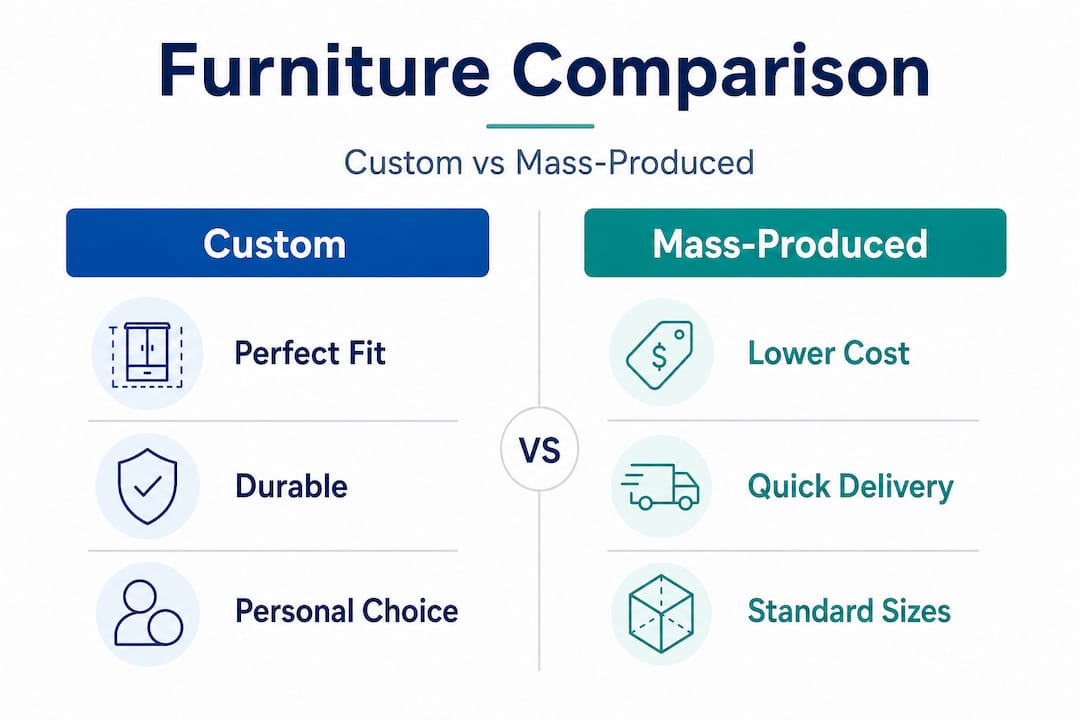
Here’s a side-by-side look at both options:
| Factor | Mass-produced | Custom |
|---|---|---|
| Upfront cost | Lower | Higher |
| Lead time | Days to weeks | 6 to 20+ weeks |
| Fit to your space | Standard sizes only | Exact dimensions |
| Style choices | Limited to catalog | Virtually unlimited |
| Durability | Varies widely | Often higher quality |
| Resale value | Depreciates fast | Can retain value |
| Best for | Renters, tight budgets, quick needs | Owners, unique spaces, long-term use |
Mass-produced furniture remains attractive for homeowners prioritizing lower upfront cost and faster availability, whereas custom is a better fit when priorities shift to fit-to-space, customization, and long-term use. The trade-off is typically higher cost and longer lead time.
Pro Tip: If you’re not ready to commit fully to custom, start with one key piece in a problem area of your home. A custom storage unit for an awkward wall niche, for example, can make a bigger daily impact than replacing multiple standard pieces.
Mass-produced furniture makes sense in specific situations. You just moved into a new place and need something functional fast. You’re renting and don’t want to invest heavily in a space you may leave. Your budget is tight and you need to furnish multiple rooms at once. In those cases, a well-chosen ready-made piece from a reputable retailer is a smart call.
But when you’re staying put, dealing with an unusual floor plan, or want your home to genuinely reflect your taste, custom starts to win. Understanding types of living room furniture helps you identify which pieces are worth investing in and which can stay mass-produced. And optimizing your living room layout first can also reveal where a custom piece would have the most impact before you spend anything.
The smartest furniture decisions are not always the cheapest ones upfront. They’re the ones that still work perfectly five years later.
Key benefits of customizing furniture for urban homes
Urban living creates specific challenges that mass-produced furniture simply was not built to solve. Smaller footprints, open-plan layouts, and the need to make spaces do double or triple duty all call for a different approach. Here are the top benefits of going custom when you live in the city.
- Perfect fit for your actual space. Custom furniture uses your exact measurements, not industry standard sizes. That means no gaps between the unit and the wall, no awkward overhang past a doorway, and no wasted inches.
- Smarter storage. Personalized storage solutions can wrap around corners, stack to ceiling height, or tuck into alcoves that standard cabinets cannot reach.
- Multi-function by design. Urban homes benefit enormously from pieces that do more than one job. A custom dining table with built-in extension leaves, a bed frame with deep drawers below, or a coffee table that rises to desk height. These are all possible with custom design.
- Reflects your personal style. You choose the wood species, the hardware, the finish, and the proportions. The result is a piece that looks like it belongs in your home because it was made for your home.
- Long-term value. Custom pieces are typically built with higher-quality materials and joinery techniques, so they last longer. A solid hardwood cabinet can last decades. A particleboard flatpack may not survive your second move.
Here’s a quick comparison of what built-in custom storage can offer versus standard freestanding units:
| Measurement | Standard freestanding unit | Custom built-in |
|---|---|---|
| Height | 72 inches (industry standard) | Floor to ceiling (up to 108 inches+) |
| Width | Fixed (typically 24, 36, or 48 inches) | Any width from 6 to 120 inches |
| Depth | 12 to 24 inches standard | Adjusted to room and function |
| Storage capacity | Baseline | Up to 40% more in the same footprint |
When you look at smart furniture choices for small spaces, the argument for custom becomes very clear very fast. An extra 40% storage capacity in the same wall space is not a minor upgrade. In a 600-square-foot apartment, that difference is significant. More ideas for maximizing tight quarters are available through space-saving furniture solutions that blend function and style without sacrificing either.
When it comes to budgeting, typical price ranges from home improvement resources give you a starting benchmark, which you then refine based on your piece type, chosen materials, and whether cabinetry or built-ins are involved.
Pro Tip: Don’t budget custom furniture like you’d budget a standard purchase. Custom projects benefit from a 10 to 15% contingency buffer on top of your quoted price, since material upgrades and small design changes during production are common.
How to plan and budget for customized furniture
The biggest reason people avoid custom furniture is not the price. It’s uncertainty. They don’t know where to start, how much to set aside, or what questions to ask. A clear process takes the guesswork out of it.
Step-by-step planning process:
- Measure your space precisely. Note height, width, depth, and any obstacles like outlets, vents, or light switches. Measure twice. Custom mistakes are costly to fix.
- Define your must-haves vs. nice-to-haves. List every feature the piece must have to solve your problem, then list desirable extras. This keeps scope manageable.
- Research material and style options. Solid wood, plywood, MDF, metal, glass. Each has a different cost and durability profile. Know which matters most for your use case.
- Set a firm maximum budget per piece. Without a number, conversations with craftsmen or shops can drift toward more expensive options quickly.
- Get at least two or three quotes. Pricing varies widely between local craftsmen, specialty furniture shops, and semi-custom retailers.
Questions to ask before placing any custom order:
- What materials are you using and why?
- What is the estimated lead time from order to delivery?
- Do you offer a warranty or guarantee on craftsmanship?
- What does your revision or change order process look like?
- Can I see samples of finishes and hardware before we finalize?
- Is delivery and installation included in the quote?
As a space planning exercise, it also helps to map out your room before finalizing any design. Knowing traffic flow, seating zones, and light sources ensures your custom piece will feel natural in the room rather than just technically correct.
Starting with benchmarks from trusted home improvement sources gives you a realistic foundation, then you adjust based on your specific project details, local labor rates, and material preferences.

Pro Tip: Avoid scope creep by agreeing in writing on what is included before work begins. Even small additions like an extra shelf, a different hinge style, or a paint upgrade can add up quickly once a project is underway.
Why custom furniture pays off: A reality check most people miss
Here’s a perspective most furniture guides skip entirely. The real cost of cheap furniture is not the purchase price. It’s the replacement cycle.
Many homeowners buy a particleboard bookcase, a mass-produced TV stand, or a fast-furniture sofa because the upfront price is appealing. Two to three years later, the piece is warped, wobbling, or simply out of style. They buy again. And again. Over ten years, those three or four replacement purchases add up to more than a single well-built custom piece would have cost at the start.
Custom is a better fit when your priorities shift to fit-to-space, customization, and long-term use. That is not marketing language. It’s a practical reality backed by how furniture actually performs over time in real homes.
There’s also an emotional cost that nobody talks about. Living with furniture that almost works, a sofa that’s slightly too big, a cabinet that doesn’t quite close right, a desk that wobbles slightly creates a low-level daily frustration. It’s not dramatic, but it chips away at how much you enjoy your own home. Furniture that truly fits your space and habits removes that friction entirely. You stop noticing the furniture and start noticing how good the room feels.
Think about upgrading your living room furniture not as a splurge but as a long-term quality-of-life investment. Families who design a custom storage wall, for instance, often find that the whole room feels more organized and calm, because the piece was built around how they actually use that space, not around what a factory decided most people need.
The conventional wisdom says go cheap first and upgrade later. We’d argue the opposite: identify the one or two pieces that cause you the most daily friction and invest in getting those right from the start. Everything else can wait.
Customize your living space with New Way Ref
If this guide has you thinking seriously about upgrading your home with furniture that actually fits your life, you’re in the right place.
At New Way Ref, we’ve curated a modern, stylish selection of furniture and home decor designed to work in real urban homes. From thoughtfully designed storage cabinets to versatile coffee tables, our products blend function and style without asking you to compromise. Whether you’re starting fresh or refreshing a single room, we make it easy to find pieces that feel intentional. Ready to take the next step? Explore our full collection or get started with custom furniture ideas at New Way Ref to find the right fit for your home today.
Frequently asked questions
Is customized furniture always more expensive?
Customized furniture typically costs more upfront, but it offers greater long-term value through durability, perfect fit, and fewer replacements. As noted in the Custom Furniture Cost Guide, custom is better suited when fit-to-space and long-term use are priorities.
How much should I budget for a custom project?
Start with Angi’s typical price ranges as a baseline, then adjust for your specific piece type, materials, and local labor costs. Adding a 10 to 15% contingency buffer is always a smart move.
How long does it take to get customized furniture?
Lead times for custom work often range from six weeks to several months, depending on the complexity of the piece and the maker’s schedule. The trade-off is longer lead time compared to ready-made options.
What types of furniture benefit most from customization?
Storage pieces, built-in units, and multi-function designs typically offer the best returns when customized, especially in compact urban spaces where every inch matters. Benchmarks from Angi’s cost guide can help you decide where to prioritize your investment.
Do I need a designer for custom furniture?
A designer is helpful for complex whole-room projects, but many local craftsmen and specialty shops can walk you through the design and build process from start to finish without additional design fees.