

TL;DR:
- Layered lighting, combining ambient, task, and accent sources, creates a balanced, inviting, and versatile environment. Relying on a single overhead fixture results in flat, uncomfortable spaces, while multiple light sources enhance depth, control, and ambiance. Proper layering improves visual comfort, emotional appeal, and energy efficiency within any room.
Most homeowners install one overhead light and call it done. The room feels flat, shadows fall in all the wrong places, and something always feels off, even when the space looks good on paper. Understanding why layer lighting types matters is the single most overlooked principle in home design. Lighting does far more than push back darkness. It shapes how a room feels, how you use it, and how welcoming it actually is. When you combine the right lighting layer combinations, you stop fighting your space and start enjoying it.
Table of Contents
- Key takeaways
- The three types of lighting explained
- Why layering lighting transforms a room
- Single source vs. layered lighting by room
- How to layer lighting in your home
- Lighting’s impact on your wellbeing
- My take on layered lighting
- Light up your space with Newwayref
- FAQ
Key takeaways
| Point | Details |
|---|---|
| Single sources fall short | One overhead light creates flat, uncomfortable spaces that lack warmth and usability. |
| Three core layers exist | Ambient, task, and accent lighting each serve a distinct purpose and work best together. |
| Balance reduces glare | Indirect-to-direct ratio between 50% and 65% creates visual comfort and reduces eye strain. |
| Dimmers add flexibility | Adjustable controls let you shift mood and function in any room throughout the day. |
| Fixtures are design objects | The form of a fixture shapes a room’s character even when the light is off. |
The three types of lighting explained
Before you can understand why layer lighting types is worth your attention, you need to know what the layers actually are. Most rooms benefit from three distinct categories, and each one does a different job.
- Ambient lighting is the base layer. It provides general illumination across the room so you can move safely and see clearly. Recessed ceiling lights, flush-mount fixtures, and chandeliers typically serve this role. Think of it as the foundation everything else builds on.
- Task lighting focuses light exactly where you need it for specific activities. A reading lamp beside your armchair, under-cabinet lights in the kitchen, and a desk lamp in your home office all qualify. Task lighting reduces eye strain because it concentrates brightness where work actually happens.
- Accent lighting is the layer most homeowners skip entirely. It highlights specific objects or features: artwork on the wall, a textured brick fireplace, open shelving with decorative items. Properly placed, accent lighting needs to be about three times brighter than your ambient level to draw the eye without disappearing into the background.
- Decorative lighting acts as a fourth, optional layer. Pendants, sconces, and statement floor lamps fall here. They contribute light but also serve as focal points in the room’s design.
Color temperature matters across all four types. Warm white light (around 2700K to 3000K) creates a relaxed, cozy feel and works well in living rooms and bedrooms. Cooler white (3500K to 5000K) supports focus and is better suited to kitchens and home offices. Mixing temperatures carelessly across layers makes a room feel incoherent. Keeping your layers in the same temperature family keeps the space feeling intentional.
Why layering lighting transforms a room
Here is the honest truth about the importance of lighting design: more light does not mean better light. Brightness alone does not create comfort. It is the balance between different sources, at different heights, with different intensities, that makes a room actually feel good to be in.
Industry guidelines recommend keeping your indirect-to-direct light ratio between 50% and 65% indirect light in residential spaces. That means more than half your light should bounce off walls and ceilings rather than hitting your eyes directly. A single overhead fixture does the opposite. It blasts direct light downward and creates harsh shadows on faces, countertops, and furniture.
“Luxury is perceived through intelligent use of lighting contrasts rather than budget scale.” The contrast of light and shadow, created deliberately through layers, is what makes a room feel designed rather than assembled.
Layering also gives you control. A living room with only a ceiling fixture either blazes at full brightness or goes dark. Add a floor lamp and a couple of table lamps, and suddenly you have a range of mood settings for movie nights, hosting friends, reading, and winding down. Lighting choices shape how you interact with your space emotionally, not just physically.
Pro Tip: Install dimmers on as many circuits as possible when you first set up your lighting. Adjusting brightness is far cheaper at that stage than rewiring later, and dimmers alone can multiply the number of moods a single room can produce.
Spatial perception shifts with layering too. Accent lights that graze a textured wall visually widen a narrow room. Uplighting in a corner draws the eye upward, making ceilings feel higher. Task lamps at seated height make large rooms feel more intimate. The perception of space and ambiance changes dramatically based on where light originates.

Single source vs. layered lighting by room
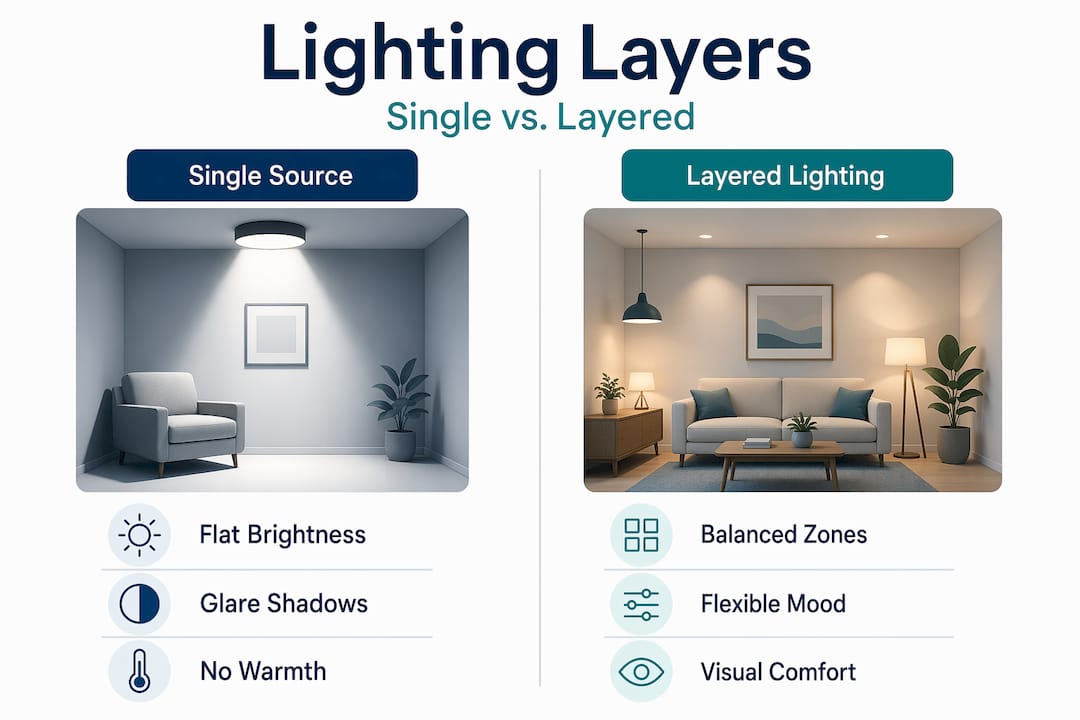
The gap between a single overhead light and a layered setup becomes obvious the moment you experience both. Here is how that contrast plays out in the rooms where you spend the most time.
| Room | Single source result | Layered lighting result |
|---|---|---|
| Living room | Flat, even glare, no focal points, unflattering for conversation | Floor lamp, table lamps, and accent lights create zones and warmth |
| Kitchen | Work surfaces cast in shadow from overhead position | Under-cabinet task lights eliminate shadows; pendant lights over island add style |
| Bedroom | Harsh direct light, difficult to wind down, no reading support | Bedside sconces, soft overhead dimmer, and accent light build a calm retreat |
| Home office | Eye strain from single source, poor contrast for screens | Desk lamp reduces eye strain, ambient light controls screen glare |
Rooms with multiple light sources at different heights feel more balanced and provide better illumination than rooms relying on a single overhead fixture. Design practice typically recommends two to three light sources per room as the baseline for comfortable, functional lighting.
The kitchen example is worth dwelling on. Most kitchens have a single ceiling fixture centered in the room. When you stand at the counter chopping vegetables, your own body blocks the light from reaching the work surface. You end up chopping in your own shadow. Under-cabinet lighting solves this completely, and it is one of the most affordable upgrades available. Adding a pendant or two over a kitchen island then layers in the accent and decorative elements that turn a purely functional room into one with visual character.
How to layer lighting in your home
Getting the layering right does not require a designer. It requires a clear sequence and a few good decisions.
-
Start with ambient lighting. Confirm your general illumination covers the room without dark corners. Recessed lighting, a ceiling fixture, or a well-placed torchiere floor lamp all work. This is your base, so get it right first.
-
Map your activity zones. Identify where you read, cook, work, apply makeup, or do anything requiring focused vision. Each of those spots needs dedicated task lighting.
-
Add accent lighting for the details you want people to notice. Art, architectural features like exposed beams, built-in shelving, and textured walls all benefit from directional spotlights or small picture lights.
-
Check your color temperature consistency. All your layers in a single room should stay within the same warm or cool range. Mixing a 2700K lamp with a 5000K recessed light in the same room creates visual tension that feels wrong even if you cannot name why.
-
Install dimmers wherever possible. Smart lighting controls dramatically improve the flexibility and mood range of any layered setup. A dimmer on your ambient circuit and a smart bulb in your accent lamp give you more combinations than you will ever need.
-
Choose fixtures with form, not just function. Accent and decorative fixtures serve as sculptural design objects that shape a room’s character even when they are switched off. A beautiful sconce or a striking pendant contributes to the room during daylight hours, not just at night.
Pro Tip: Avoid placing all your light sources at the same height. Ceiling fixtures, table lamps, and floor lamps at different levels create the layered, dimensional effect that single-plane lighting simply cannot produce. Variety in height is just as important as variety in type.
Common pitfalls to sidestep: do not rely on a single bright bulb in a decorative fixture and call it layered. Do not place task lighting so far from the work surface that it creates more glare than clarity. And do not forget that the practical tips for placement of each fixture type in different rooms are just as important as the type of fixture you choose.
Lighting’s impact on your wellbeing
There is a reason why some rooms make you want to stay and others make you want to leave. Lighting is often the hidden factor. Good lighting design considers human wellbeing, orientation, and social comfort alongside energy efficiency. It is a people-centered decision, not just an aesthetic one.
The quality of light, measured partly by its Color Rendering Index (CRI), affects how accurately you see colors and how alert or relaxed you feel. A high CRI (90 and above) makes food look appetizing, skin tones appear natural, and fabrics show their true colors. A low CRI bulb makes everything look slightly washed out or yellow, and most people feel it without knowing what to name it.
“Lighting has become the main character of modern interiors, creating emotional character and spatial depth through the contrast of light and shadow.”
This trend toward lighting as emotional design is not just an interior designer’s talking point. It reflects how much time people spend at home and how directly the quality of that environment affects daily life. Optimal lighting types for rooms shift that environment from neutral to genuinely supportive of how you want to feel and function in each space.
Energy efficiency fits naturally into layered design too. When you can switch on only the task lamp for a quiet reading session instead of flooding the entire room with overhead light, you use less energy. Strategic layering and smart controls together lower consumption without sacrificing comfort.
My take on layered lighting
I spent years relying on a single ceiling fixture in my living room and wondering why the space never felt as good as the ones I saw in design magazines. The furniture was right. The colors worked. But it always felt flat. The moment I added a floor lamp in one corner and a pair of table lamps flanking the sofa, the room changed completely. Not the walls, not the furniture. Just the light.
What I have learned is that most homeowners underestimate how much of a room’s personality comes from its lighting. We obsess over paint colors and cushion fabrics, then plug in a single bulb and declare the room finished. The result is a space that looks designed in photos and feels ordinary in person.
The other lesson I keep coming back to is this: prioritize light quality over sheer brightness. A 40-watt equivalent bulb with a CRI of 95 will make your room feel better than a 100-watt equivalent with a CRI of 70. Start small. Add one floor lamp. Try an under-cabinet strip in the kitchen. Watch how the room shifts. Layering does not have to happen all at once. Gradual changes teach you more about your space than any single renovation project.
— Enn
Light up your space with Newwayref

If you are ready to put these principles into practice, Newwayref has a thoughtfully curated selection of lighting fixtures designed to work across all three layers. From modern pendant lights and sleek floor lamps to accent sconces and under-cabinet solutions, every piece is chosen for both style and function. Whether you are starting from scratch in a new room or adding layers to a space that already exists, the right fixture makes the difference. Browse the full lighting collection at Newwayref to find ambient, task, and accent options that fit your home and your style. Free shipping on orders over $50 makes it easy to try more than one layer at a time.
FAQ
What does it mean to layer lighting types?
Layering lighting means combining ambient, task, and accent light sources in a single room so each one serves a different purpose. Together, they create balanced illumination, reduce glare, and give you control over mood and function.
Why is a single overhead light not enough?
A single ceiling fixture creates flat, direct light that casts shadows in work areas and lacks the warmth needed for comfortable living. Rooms with multiple sources at varying heights consistently feel more balanced and inviting.
How many light sources should a room have?
Most rooms benefit from two to three light sources as a minimum. The exact number depends on room size and how many activity zones exist, but one source per zone plus a general ambient layer is a practical starting point.
What is the best color temperature for home lighting?
Warm white light between 2700K and 3000K suits living rooms, dining rooms, and bedrooms. Cooler temperatures in the 3500K to 4000K range work better in kitchens and home offices where clarity and focus matter more.
Do dimmers really make a difference in layered lighting?
Yes. Dimmers and smart controls significantly improve the range of moods and functions a layered setup can produce. They let you adjust the balance between layers throughout the day without changing a single fixture.