

TL;DR:
- Most homes rely on a single overhead light, which creates flat, uninteresting spaces lacking depth and flexibility. Layered lighting combines ambient, task, and accent sources to improve room functionality, mood, and energy efficiency. Implementing small, strategic changes like dimmers, additional lamps, or accent lights can dramatically enhance comfort and style without costly renovations.
Most homeowners assume a single overhead light handles everything. It doesn’t. That one ceiling fixture floods your room with flat, uniform brightness that wipes out depth, hides architectural details, and makes every activity, whether you’re reading, cooking, or unwinding, feel the same. The result is a room that functions but never quite feels right. Layered lighting fixes this by giving you control over how your space looks and feels at any moment of the day. This article breaks down exactly what layering means, how each layer works, and how you can apply it room by room.
Table of Contents
- What does layered lighting really mean?
- The three layers: Ambient, task, and accent lighting
- Why layering enhances comfort, control, and mood
- Layered lighting and energy efficiency: The hidden connection
- How to get started: Layer lighting in every room
- Why most homes get lighting wrong—and how layering changes everything
- Ready to transform your home with layered lighting?
- Frequently asked questions
Key Takeaways
| Point | Details |
|---|---|
| Layering boosts comfort | Mixing different lighting types makes any space more inviting, flexible, and useful. |
| Not all lights are equal | Ambient, task, and accent lighting each play a unique role for function and style. |
| Smart controls matter | Switches, dimmers, and portable options help you get the most from lighting layers. |
| Saves energy | Purposeful layering and using daylight can lower energy use compared to just turning up one big light. |
What does layered lighting really mean?
With the common pitfalls of one-note lighting now clear, let’s define what professionals mean when they talk about layered lighting and why it’s foundational to great interiors.
Layered lighting is the practice of combining multiple light sources, each serving a different purpose, into one cohesive system. Rather than asking a single fixture to do all the work, you distribute light intentionally across three distinct categories: ambient, task, and accent. This approach, which you can explore in detail through this layered lighting explained guide, gives you flexibility that a single fixture simply cannot deliver.
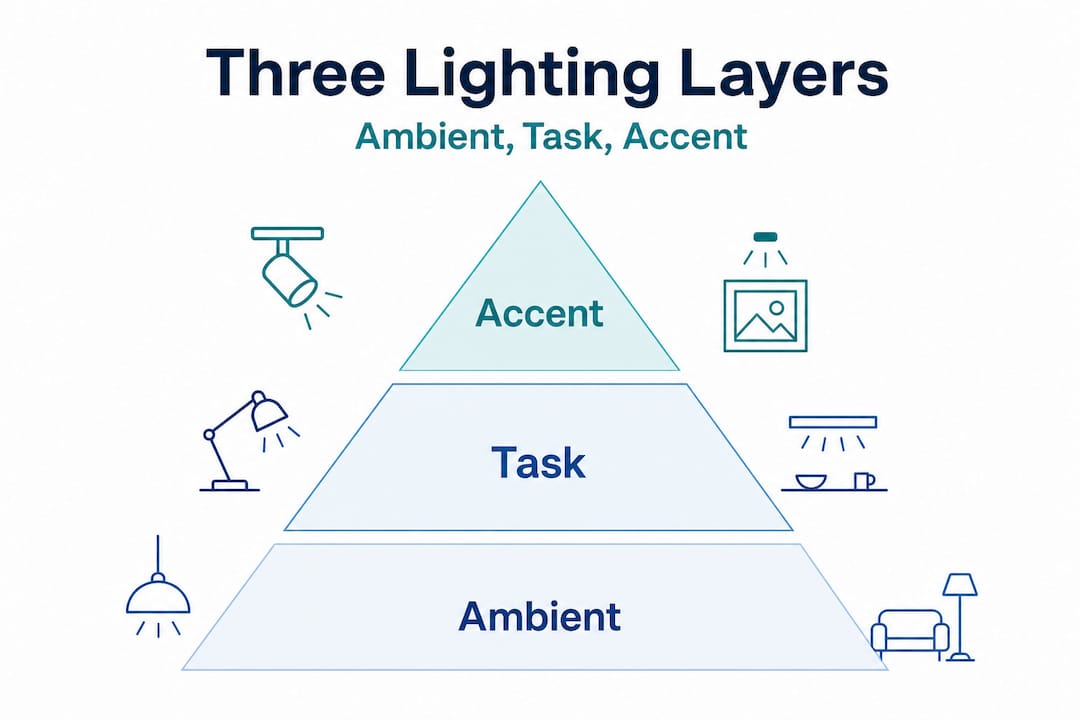
The practical case is strong. As Redfin reports, layered lighting improves how a room functions, looks, and feels by replacing a single overhead fixture with a blend of ambient, task, and accent sources. That combination creates depth, visual comfort, and adaptability that flat, one-source lighting never achieves.
Here is a quick overview of what each layer contributes:
- Ambient lighting: The base layer, providing general illumination across the entire room
- Task lighting: Focused and directed at specific work zones
- Accent lighting: Decorative and dramatic, used to highlight features or add personality
Why a single overhead light falls short
Think about what happens in your living room on a typical evening. You might be reading in one corner, watching TV from the couch, and occasionally walking to the kitchen. A single ceiling light treats all of those activities the same way, with the same intensity and direction. That creates glare, awkward shadows, and visual fatigue. Understanding ambient lighting basics clarifies why even good ambient light needs partners to create a truly functional space.
| Lighting approach | Room feel | Flexibility | Visual comfort |
|---|---|---|---|
| Single overhead only | Flat, uniform | Very low | Poor |
| Ambient plus task | Functional | Moderate | Good |
| Full three-layer system | Dynamic, inviting | High | Excellent |
The three layers: Ambient, task, and accent lighting
Now that we’ve outlined the principle, it’s time to detail exactly what the three key lighting layers are and how they serve you at home.
Each layer has a specific job. When all three work together, the effect is noticeably different from what any single source can produce.
Ambient lighting
Ambient is your foundation. It provides the base level of brightness that lets you move safely through a room and see general shapes and furniture. Examples include ceiling fixtures, recessed lighting, chandeliers, and flush-mount lights. Think of it as the background brightness setting for the entire space.
Task lighting
Task lighting zooms in. It delivers focused, stronger light exactly where you need it for specific activities. A desk lamp, under-cabinet kitchen lights, a reading lamp beside your bed, or vanity lights in the bathroom all count as task lighting. The key is that task light is directed, not scattered. It reduces eye strain during close-up work and keeps brightness concentrated where it matters most.

Accent lighting
Accent lighting is where personality enters the room. Wall sconces, picture lights, LED strips behind shelves, and directional spotlights all qualify. Accent lighting draws the eye toward specific features, like artwork, architectural details, bookshelves, or textured walls. Reviewing these accent lighting tips will show you how dramatically a well-placed accent can shift a room’s whole atmosphere.
As Angi notes, each of these layers has a unique role, and together they let you adjust brightness to support both productivity and relaxation. That dual function, working hard and resting well in the same room, is what makes layering so valuable. You can learn more about lighting’s role in home design to see how professionals approach this balance.
| Layer | Primary function | Common examples | Best placement |
|---|---|---|---|
| Ambient | General illumination | Ceiling fixtures, recessed lights | Centered or distributed overhead |
| Task | Activity-specific focus | Desk lamps, under-cabinet lights | Directly above or beside work areas |
| Accent | Highlighting and drama | Wall sconces, LED strips, art lights | Walls, shelves, and focal points |
Pro Tip: If possible, put each layer on its own switch or dimmer. When ambient, task, and accent are all wired to the same control, you can’t adjust them independently, which defeats the whole purpose of layering.
Why layering enhances comfort, control, and mood
Defining these layers is helpful, but it’s the comfort and personal control they provide that truly set them apart. Here’s why that matters for your daily life.
Your needs shift throughout the day. Bright, even light is useful for morning routines and focused work. Softer, warmer light works better for winding down in the evening. Dramatic accent lighting creates the right feel for entertaining guests. A layered system adapts to all of these situations because you control each layer separately.
The U.S. Department of Energy confirms that layered lighting improves control and comfort by letting you match light output to the activity, especially when paired with dimmers and smart controls. This is a straightforward concept with a big practical payoff.
Here are the most common ways layered lighting adapts to real daily activities:
- Reading: Turn up task lighting from a dedicated lamp while dimming ambient overhead light to reduce screen glare
- Cooking: Activate under-cabinet task lights for clear counter visibility without harsh overheads washing everything out
- Relaxing: Dim ambient lights and let accent lights carry the mood with warm, low-level glow
- Entertaining: Balance all three layers at moderate levels for a welcoming, lively atmosphere
- Cleaning: Bring all lights to full brightness for clear visibility without shadows
- Sleeping: Switch off ambient and task layers entirely while leaving a soft night light or accent strip
“The real value of layered lighting comes not from the fixtures themselves, but from the ability to control them independently. A room with three layers wired to one switch is barely an improvement over a single fixture.”
These cozy interiors with lighting layers ideas show exactly how different layer combinations create distinct moods. For a deeper look at how light affects how you feel at home, the guide on lighting to enhance mood is worth reading.
Pro Tip: Add a simple plug-in dimmer to your most-used floor or table lamps. It costs very little and immediately gives you the ability to shift ambient mood without rewiring anything.
Layered lighting and energy efficiency: The hidden connection
Personal comfort is just one benefit. The hidden power of layered lighting is what it can do for your energy bills and the environment.
A widespread belief in home lighting is that brighter always means better. In practice, over-relying on high-output overhead lighting wastes energy and rarely improves how a room looks or functions. A 2025 systematic literature review found that when light is used for specific visual functions and when daylight is leveraged effectively, energy demand drops significantly compared to approaches that depend entirely on electric lighting. The contrast is notable: over-relying on constant electric lighting can increase energy use by up to 300% compared to purposeful, layered strategies.
The logic is simple. Instead of running one powerful light to cover an entire room, you run a lower-intensity ambient source and add task lighting only where you need it. The total wattage is often lower, and the quality of light is better because it’s targeted.
| Strategy | Estimated energy approach | Light quality |
|---|---|---|
| Single bright overhead | Always on, full power | Flat and uniform |
| Ambient plus task | Reduced ambient, task as needed | Focused and effective |
| Full layers with dimmers | Flexible, lowered overall output | Dynamic and efficient |
| Full layers plus daylight | Minimum electric use | Optimal and varied |
Key insight: Using modern lighting trends like tunable LEDs and smart controls alongside layering gives you the best of both efficiency and atmosphere. You can also supplement your system by increasing natural light through window treatments and reflective surfaces, which reduces how much electric light you need during daylight hours.
How to get started: Layer lighting in every room
Knowing why to layer your lighting sets you up, but knowing how to do it makes the difference. Let’s break down next steps by room.
Layered lighting is effective because it adapts to different tasks, supports relaxation, and fits a range of home layouts, whether you’re in a studio apartment or a three-bedroom house, as Angi confirms. You don’t need a renovation to start. Many of the best improvements are simple swaps and additions.
Here is a practical sequence you can follow for each main room in your home:
- Identify your ambient source. In most rooms, this already exists. Check if it’s on a dimmer; if not, consider adding one.
- Add task lighting where you actually work or read. A floor lamp beside the sofa, a desk lamp in your workspace, or under-cabinet lights in the kitchen all qualify.
- Choose one accent element. A wall sconce, a picture light, or LED strips behind a shelf introduce dimension without major changes.
- Put layers on separate controls where possible. Smart plugs and plug-in dimmers make this achievable for renters without any electrical work.
- Experiment with bulb color temperature. Warm white (2700K to 3000K) suits bedrooms and living areas. Cooler white (3500K to 4000K) works better in kitchens and offices.
- Assess and adjust. Live with your changes for a few days, then tweak brightness levels or add a piece where light still feels flat.
For renters and people in small spaces, portable solutions are your best friend. Floor lamps, table lamps, and LED strip lights require no installation and can move with you. This lighting selection workflow walks you through choosing the right fixtures for each layer in any room size.
Pro Tip: Start in the room you spend the most time in. Getting your living room or bedroom right first gives you a clear sense of how layering feels, and makes it easier to replicate the approach in other spaces. These arranging lighting tips are practical starting points for any layout.
Why most homes get lighting wrong—and how layering changes everything
With practical strategies in your toolkit, let’s rethink what makes layered lighting so powerful, especially for homes stuck in old habits.
Here’s the uncomfortable truth about home lighting: most spaces are lit the way they are because nobody made a deliberate choice. Builders install one ceiling fixture per room because it’s the minimum requirement. Renters accept it. Homeowners repaint and refurnish without ever questioning why the room still doesn’t feel right after all the effort.
The stubborn myth of “one ceiling light is enough” persists because the problems it creates are subtle. Rooms feel a little flat. People feel slightly tired without knowing why. Entertaining never quite achieves the warm atmosphere you’re going for. None of these issues scream “lighting problem,” so they go unfixed.
But the results of correcting this are outsized relative to the effort involved. Adding a single dimmable floor lamp to a living room changes the room’s entire character in the evening. Moving a table lamp to highlight a bookshelf creates a focal point where there was none. These are not expensive renovations. They are small, strategic decisions that compound into a noticeably better space. You can see exactly how these benefits play out in this overview of benefits of modern lighting for contemporary homes.
The most dramatic improvements rarely come from buying the most expensive fixture. They come from changing how you control the light you already have, or adding a simple layer where one is missing. A dimmer switch, a well-placed lamp, or a plug-in accent light can deliver more noticeable results than a full fixture replacement at ten times the cost.
The takeaway is straightforward. Don’t wait for a renovation to start layering. Experiment now with what you can control, change, or add easily. The difference in how your space feels, and how much you enjoy spending time in it, is usually immediate.
Ready to transform your home with layered lighting?
Inspired to try layering? Here’s where to find the right products and ideas to get moving.

You don’t need to overhaul your entire home at once. Start with one room, add a lamp, swap a bulb, introduce a dimmer, and see how quickly the atmosphere shifts. At New Way Ref, you’ll find a thoughtfully curated selection of modern lighting fixtures, home accessories, and decor pieces designed to work together. From accent lamps to statement ceiling lights, the range covers every layer you need. Browse the full collection at New Way Ref to find pieces that match your style and help you build a lighting scheme that’s as functional as it is beautiful. Free shipping on orders over $50 makes it easy to get started.
Frequently asked questions
What are the main types of lighting to layer?
The three essential layers are ambient (overall illumination), task (focused on specific activities), and accent (highlighting features and adding personality). Layered lighting blends all three for a complete, flexible system.
Can layered lighting reduce my energy bills?
Yes. Using targeted layers alongside natural daylight reduces the need for constant high-output electric lighting. Layering controls and daylight can meaningfully lower energy demand compared to single-source approaches.
What’s the easiest way to add layers in a rental apartment?
Portable lamps, plug-in LED strip lights, and plug-in dimmers are the fastest non-permanent options. They require no installation and can be removed when you move out.
Why doesn’t my space feel comfortable with just one light source?
A single light source creates uniform brightness with no depth, leading to harsh shadows and no ability to adapt to different activities or moods. Layered lighting supports the flexibility and comfort that one source simply cannot provide.
Does using more lights always mean higher energy costs?
No. Targeted layering uses the right lights at the right intensity for each task, often lowering total energy use. More light is not better; precise, purposeful lighting improves both efficiency and quality.