

TL;DR:
- Effective storage solutions organize belongings, reduce clutter, and enhance home comfort during transitions or renovations.
- Choosing the right combination of home furniture, offsite units, and digital tools depends on security, accessibility, and cost considerations.
Storage solutions are systems or methods designed to efficiently organize, protect, and maximize the usability of your home’s living space. Whether you’re a homeowner with a basement full of forgotten boxes or a renter working with limited square footage, the right storage strategy transforms how your space feels and functions. Clutter is not just an aesthetic problem. It creates stress, wastes time, and shrinks the usable area of your home. Understanding why storage solutions matter is the first step toward reclaiming your space and living more comfortably.
Why storage solutions matter for everyday home life
The core benefit of any storage system is simple: it puts things where they belong so you can find them, use them, and move on. Moving infrequently used items to external or dedicated storage improves living comfort by clearing floor space and maintaining organization. That freed-up space is not just visual. It changes how you move through your home and how relaxed you feel in it.

Clutter has a measurable cost beyond inconvenience. Storage mismanagement causes hidden costs including wasted time searching for items, household disruptions, and even insurance liability in some cases. Treating storage as a form of risk control, not just tidying up, reduces those surprises and keeps your home running smoothly.
Here are the practical benefits that well-planned storage delivers:
- Decluttering and space recovery. Clearing surfaces and floors makes rooms feel larger and reduces daily friction. You stop stepping over things and start using your space intentionally.
- Protection of valuables. Climate-controlled storage safeguards wood furniture, electronics, and sentimental items from humidity, temperature swings, and physical damage.
- Flexibility during life changes. Flexible storage solutions adapt to changing needs without long-term commitment, making them ideal for moves, renovations, or downsizing.
- Improved access and convenience. Well-organized storage means you spend less time searching and more time doing. Self-storage facilities with 7-day access schedules turn storage from a backup plan into a daily-use tool.
Pro Tip: Label every storage bin or box on the side, not the top. When items are stacked, side labels are the only ones you can actually read without moving everything.
How do different types of storage solutions compare?
Not every storage need is the same, and no single solution covers everything. The most effective approach is a hybrid model that combines local physical storage furniture, offsite self-storage units, and digital organization tools for documents and media. Each type serves a distinct role in your home’s overall organization system.
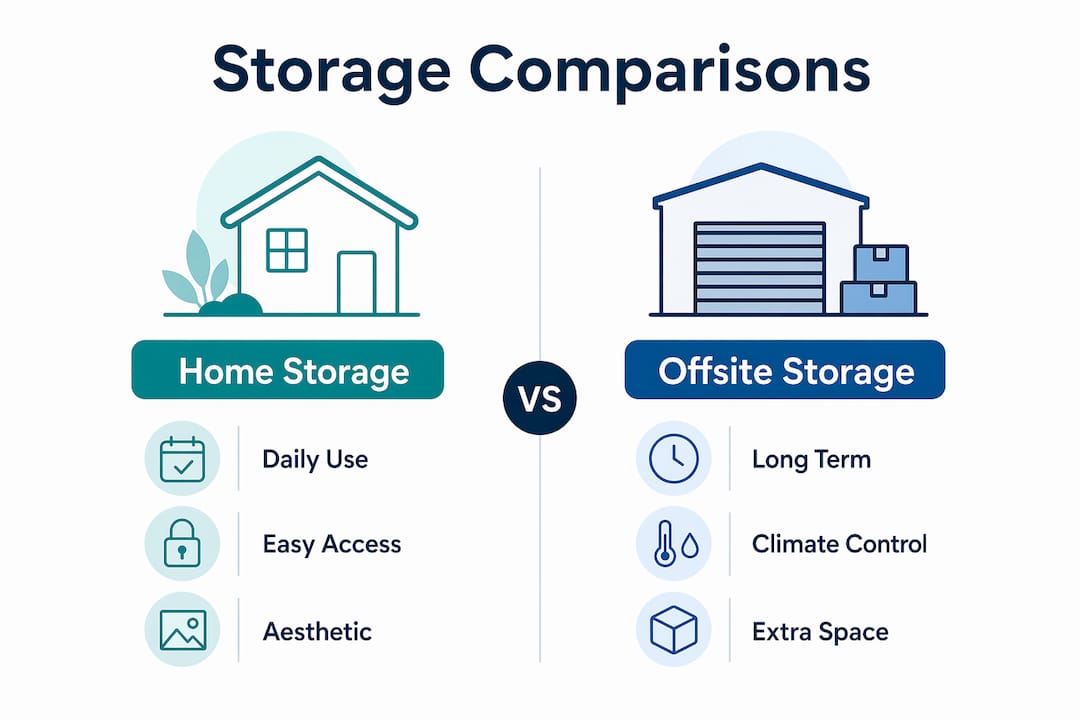
| Storage type | Best for | Key advantage | Limitation |
|---|---|---|---|
| Home storage furniture | Daily-use items, shoes, linens, kitchen goods | Immediate access, adds to decor | Limited capacity |
| Offsite self-storage units | Seasonal items, furniture, archived belongings | Large capacity, security features | Requires travel to access |
| Digital/cloud storage | Documents, photos, media files | Accessible anywhere, no physical space needed | Does not replace physical storage |
| Hybrid combination | Full household organization | Balances access, cost, and protection | Requires planning to set up |
Local storage is best for high-frequency access, while cloud-based tools provide long-term redundancy for digital files. That distinction matters because mixing the two without a plan leads to duplication and confusion. A layered hybrid strategy offers resilience by balancing immediate use, semi-active access, and long-term offsite protection, giving you the right item in the right place at the right time.
Storage furniture from brands like Newwayref, including shoe cabinets, sideboards, and multi-functional coffee tables, handles the daily-access layer well. These pieces keep your most-used items organized and visible without requiring a trip to an offsite unit. For items you need twice a year, a self-storage unit with CCTV, alarmed units, and PIN access provides the security and capacity that home furniture cannot.
What should you look for when choosing a storage solution?
Choosing the right storage option comes down to five factors. Work through each one before committing to a system or facility.
- Security features. Security features like CCTV, alarmed units, and PIN access protect sentimental and financially valuable items. For home storage furniture, look for lockable compartments and solid construction.
- Climate control. Stable temperature and humidity prevent warping, cracking, and degradation in wood furniture, electronics, artwork, and clothing. If you store anything sensitive, climate control is not optional.
- Flexible rental terms. Storage spaces that can be adjusted without long-term commitment reduce expenses while providing convenient access. Month-to-month contracts are standard at reputable self-storage facilities and worth prioritizing.
- Accessibility hours and location. A storage unit you can only access during business hours is a unit you will rarely use. Facilities offering extended or 24-hour access genuinely change how useful the space becomes.
- Total cost of ownership. Monthly fees are only part of the picture. Factor in travel time, packing materials, insurance, and the time you spend managing the system. Cost evaluation should consider total ownership including management time and risk, not just the monthly rate.
Pro Tip: Before renting an offsite unit, measure your largest items first. Most people underestimate how much space a sofa or dining table actually takes up, and end up paying for a unit that is either too small or far larger than needed.
For home furniture storage, the same logic applies. A shoe cabinet that holds 12 pairs but your household owns 30 creates overflow clutter immediately. Match capacity to your actual inventory, not your ideal inventory.
How storage solutions help during renovations, moves, and downsizing
Life transitions are where the importance of storage solutions becomes most obvious. Three scenarios stand out: home renovation, moving between properties, and downsizing.
- Home renovation. Effective storage improves home renovation by protecting belongings and providing clear, safe spaces for construction work. Contractors work faster and more safely when rooms are clear. Damage to furniture left in a renovation zone is one of the most common and avoidable costs homeowners face.
- Moving transitions. Timing a sale and a purchase rarely lines up perfectly. Temporary storage fills that gap without forcing you to rush decisions or pay for overlapping leases. Storage acts as a buffer in life transitions, and decluttering for daily efficiency is a near-universal benefit reported by people who use it during moves.
- Downsizing. Moving to a smaller home does not mean discarding everything you value. Long-term storage lets you keep meaningful furniture, family heirlooms, or hobby equipment without cramming them into a smaller space. This is especially relevant for retirees and empty nesters who want to prioritize storage furniture in their new space without sacrificing comfort.
The common thread across all three scenarios is reduced stress. When your belongings are protected, organized, and accessible, you make better decisions about your home and your next steps. Rushing because you have nowhere to put things leads to regret. Good storage planning removes that pressure entirely.
Key takeaways
Effective storage solutions protect your belongings, free up living space, and give you the flexibility to handle any life transition without chaos.
| Point | Details |
|---|---|
| Decluttering improves daily life | Clearing floor space and surfaces reduces stress and makes rooms feel larger. |
| Hybrid storage works best | Combining home furniture, offsite units, and digital tools covers all access and protection needs. |
| Security and climate control matter | Look for CCTV, alarmed units, and stable temperature environments to protect valuable items. |
| Flexibility reduces long-term cost | Month-to-month contracts and modular options prevent overpaying during changing life stages. |
| Storage supports major transitions | Renovation, moving, and downsizing all become less stressful with a clear storage plan in place. |
Storage is the one home investment most people make too late
I have seen this pattern more times than I can count. Someone spends months planning a kitchen renovation or a bedroom refresh, but gives zero thought to where everything goes during the process. Then the furniture gets stacked in the garage, tools get damaged, and the project takes twice as long because the contractor cannot move freely. The renovation budget absorbs costs that a simple storage plan would have prevented.
The same applies to everyday home organization. Most people wait until clutter becomes a genuine problem before acting. By that point, the habit of disorganization is already set, and fixing it takes real effort. Starting with even one well-chosen storage piece, a shoe cabinet by the door, a sideboard in the hallway, a multi-use coffee table with drawers, changes the default behavior of your household.
What I find most useful is the idea that the best storage arrangement feels invisible. It protects what matters, supports your access needs, and leaves no trail of clutter. You stop noticing it because everything is simply where it should be. That is the goal. Not a perfectly styled storage room, but a home where finding things takes seconds and putting them away takes even less. The value of flexible, modular options aligned with your changing needs is that they grow with you rather than forcing you to start over every few years.
One common mistake I see is underestimating access needs. People choose a storage unit based on price and size, then realize it is 40 minutes away and only accessible on weekdays. They stop using it within three months. Location and access hours are not secondary considerations. They determine whether a storage solution actually works in your life.
— Enn
Transform your space with Newwayref storage furniture
If you are ready to put these ideas into practice, Newwayref offers a thoughtfully curated selection of modern storage furniture designed for real homes. From shoe cabinets and sideboards to multi-functional coffee tables with built-in storage, each piece is chosen for both function and style. Free shipping is available on orders over $50, and the product range covers every room in your home. Whether you are setting up a new space, simplifying a cluttered one, or planning a renovation, Newwayref has storage options that fit your needs without requiring a long-term commitment. Browse the full collection and find the right fit for your space today.
FAQ
What are storage solutions, exactly?
Storage solutions are any systems, furniture, or services designed to organize, protect, and maximize the usable space in your home. They include home storage furniture like cabinets and shelving, offsite self-storage units, and digital tools for organizing documents and media.
How do storage solutions help with home renovations?
Storage solutions protect your belongings during construction and give contractors clear space to work, which often speeds up project completion and reduces damage risk. Moving furniture and valuables to a dedicated storage area before renovation begins is one of the most cost-effective steps you can take.
What is climate-controlled storage and when do you need it?
Climate-controlled storage maintains stable temperature and humidity levels to prevent warping, cracking, and degradation of sensitive items. You need it for wood furniture, electronics, artwork, musical instruments, and clothing stored for more than a few weeks.
How do you choose between home storage furniture and an offsite unit?
Use home storage furniture for items you access daily or weekly, and an offsite unit for seasonal, bulky, or rarely used belongings. A hybrid approach combining both types gives you the best balance of convenience, capacity, and cost.
Are flexible storage contracts worth the extra cost?
Yes. Month-to-month storage contracts cost slightly more per month than long-term leases, but they prevent you from paying for space you no longer need. For renters and homeowners going through transitions like moves or renovations, that flexibility saves money overall.